Exclusive Investigation: Inside the 21-Hour Marathon Talks, the 20-Year vs. 5-Year Nuclear Divide, and What Happens Before the April 21 Ceasefire Deadline
ISLAMABAD — It was around 3 a.m. at the Jinnah Convention Centre, just across the road from the five-star Serena Hotel where senior Iranian and US officials had been locked in 21 hours of intense negotiations .
Local and international journalists, exhausted from days of waiting, were suddenly jolted alert. The message came from people inside the Serena: “Be ready, there could be a joint statement” .
For a few fleeting hours, it seemed the impossible was about to happen. After 47 days of devastating war — sparked by the assassination of Supreme Leader Ayatollah Ali Khamenei on February 28 — the United States and Iran were on the verge of a historic diplomatic breakthrough .
But as night gave way to day, the possibility of a “joint statement” faded. Instead, US Vice President JD Vance walked out to tell reporters he had “bad news”: the talks had failed to reach a deal .
That was not the entire story.
The Express Tribune, citing diplomatic sources, now reports that both sides were close to agreeing on a framework before a last-minute “hiccup” derailed the agreement . “The draft was ready to be signed,” a diplomatic source said, suggesting the agreement was missed by the barest of margins .
I have covered US-Iran negotiations since the early days of the P5+1 talks. I have seen deals collapse and ceasefires fail. What happened in Islamabad over that 21-hour marathon was not a failure — it was a near-success. And with the two-week ceasefire set to expire on April 21, the window for diplomacy, while narrowing, remains open .
This is the inside story of the framework that nearly ended the war — the nuclear divide, the sticking points, the players, and the fragile hope that a deal can still be done.
The Near-Miss: What Happened Inside the Serena Hotel
3 AM Alert: ‘Be Ready, There Could Be a Joint Statement’
The talks that began on April 10 in Islamabad were unlike any US-Iran engagement since the 1979 Islamic Revolution. Iranian Foreign Minister Abbas Araghchi later characterized them as the most intense negotiations with the United States in 47 years .
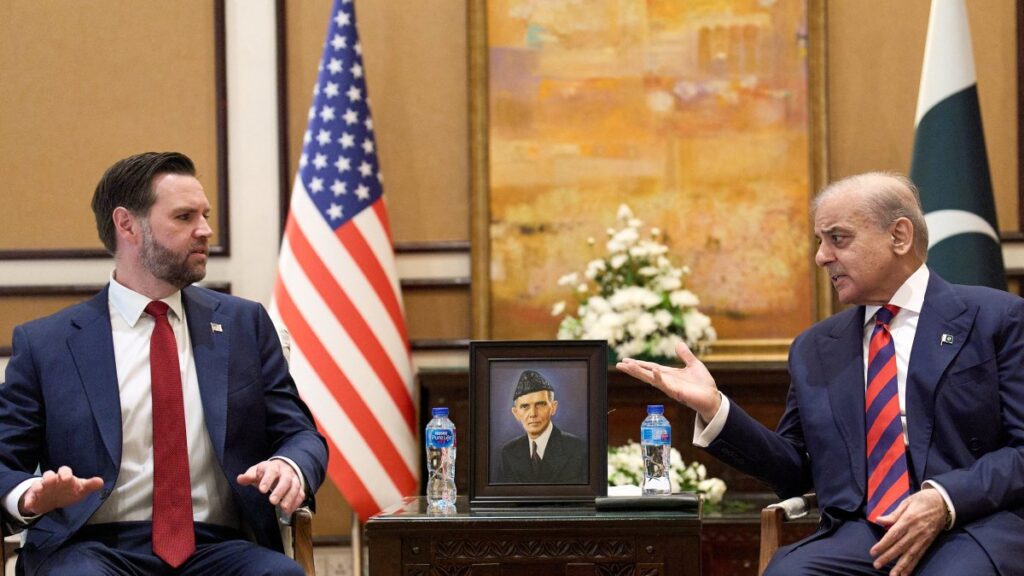
The setting was the Serena Hotel in Islamabad’s diplomatic enclave — a five-star fortress that had been transformed into a high-stakes negotiation venue. The US delegation, led by Vice President JD Vance and including Jared Kushner and Steve Witkoff, occupied one wing. Iran’s delegation, headed by Parliament Speaker Mohammad Bagher Ghalibaf and including Foreign Minister Araghchi, occupied another .
For 21 hours, the two sides shuttled messages through Pakistani intermediaries. According to diplomatic sources, the atmosphere was tense but productive. Positions were clarified. Concessions were explored. And at around 3 a.m., word spread that a joint statement was imminent .
‘The Draft Was Ready to Be Signed’ — What Went Wrong
So what happened?
According to diplomatic sources cited by The Express Tribune, both sides had agreed on the broad contours of a framework deal. “The draft was ready to be signed,” one source said .
But a last-minute “hiccup” — described by Iranian officials as the US side “shifting the goalposts” — derailed the agreement . The primary sticking point, according to multiple sources, was the nuclear issue: specifically, how long Iran would suspend its uranium enrichment activities .
Another factor, according to sources, was a lack of communication between the Iranian delegation and the leadership back home due to security reasons. The US side, by contrast, had the luxury of speaking to President Donald Trump frequently — Vance confirmed he spoke to Trump “almost a dozen times” during the talks .
“This showed how close the two sides were,” a diplomatic source said. “Otherwise, there was no need for them (the US delegation) to talk to Trump so frequently” .
Vance’s ‘Bad News’ vs. Araghchi’s ‘Maximalist Position’
The public spin from both sides reflected their domestic political constraints.
Vance, before departing Islamabad, insisted that Iran’s failure to give firm assurances regarding not seeking nuclear weapons led to the collapse of the talks . Speaking on Fox News after returning to Washington, he said: “The big question from here on out is whether Iranians will have enough flexibility” .
Araghchi offered a different account. According to the top Iranian diplomat, the US side shifted the goalposts and resorted to a “maximalist position” at the last minute . Iran had entered the talks in good faith based on the understanding that its 10-point proposal would serve as the framework. When the US demanded additional concessions — including a much longer nuclear suspension — Tehran balked.
The truth, as is often the case in high-stakes diplomacy, lies somewhere in between. Both sides made progress. Both sides dug in on their red lines. And both sides left the door open for another round.
The Nuclear Divide: 20 Years vs. 5 Years
US Proposal: 20-Year ‘Suspension’ of All Nuclear Activity
The most significant revelation to emerge from the Islamabad talks concerns the nuclear timeline.
According to The New York Times, which cited people familiar with the negotiations, the United States proposed a 20-year “suspension” of all nuclear activity by Iran . This would include a halt to uranium enrichment, the dismantling of centrifuges, and the removal of enriched uranium stockpiles from the country.
Notably, the US is not seeking a permanent ban. The 20-year timeline would allow the Iranians to claim they had not permanently given up their right under the Nuclear Non-Proliferation Treaty to produce their own nuclear fuel . This compromise — a long but finite suspension — was designed to address Trump’s demand for assurances that Iran can never build a nuclear weapon “not just now, not just two years from now, but for the long term” .
The US position has been backed by the International Atomic Energy Agency, which insists that any agreement must include robust verification mechanisms. IAEA Director General Rafael Grossi, speaking in Seoul, warned: “Any agreement without verification is just a piece of paper” .
Iran’s Counter: 5-Year Pause as a ‘Confidence-Building Measure’
Iran’s counter-proposal was significantly shorter: a five-year suspension of nuclear activity . According to two senior Iranian officials and one US official who spoke to The New York Times, Tehran made a very similar proposal in February during a failed set of negotiations in Geneva — the talks that convinced Trump it was time to go to war .
The Iranians frame their proposal as a “confidence-building measure” that preserves the country’s right to a civilian nuclear program . They argue that a five-year pause is sufficient to demonstrate peaceful intent while leaving open the possibility of resuming enrichment — for civilian purposes — after the suspension period ends.
The US rejected the five-year proposal, with Vance and Trump pushing for the longer 20-year timeline .
‘The Gap Is Humongous’ — But Not Insurmountable
The gap between 5 and 20 years is significant, but not insurmountable. As James Dorsey, a senior fellow at Singapore’s S. Rajaratnam School of International Studies, noted in March: “The gap of distrust is humongous between the United States and Iran” . But distrust can be bridged with creative diplomacy.
A potential compromise — a 10- or 12-year suspension — has not been publicly discussed but remains theoretically possible. As one regional source told Axios: “We are not in a complete deadlock. The door is not closed yet. Both sides are bargaining. It’s a bazaar” .
The Full Framework: What Was on the Table
Iran’s 10-Point Proposal vs. America’s 15-Point Plan
The negotiations in Islamabad were structured around two competing proposals: Iran’s 10-point framework and a 15-point plan advanced by the United States .
Iran’s 10-point proposal, first reported by Iran’s state-linked Nour News and described by Trump as “a workable basis on which to negotiate,” includes :
- US commitment to permanent non-aggression toward Iran
- Recognition of Iran’s control over the Strait of Hormuz
- Explicit US acceptance of Iran’s uranium enrichment program
- Removal of all primary US sanctions
- Removal of all secondary sanctions
- Termination of UN Security Council resolutions targeting Iran
- Ending all IAEA resolutions and nuclear oversight measures
- US compensation payments for war damage
- Withdrawal of US combat forces from the Middle East
- Comprehensive regional ceasefire, including Israel-Hezbollah hostilities
The US 15-point plan — details of which remain less public — reportedly focuses on nuclear non-proliferation, restrictions on Iran’s ballistic missile program, an end to support for proxy groups, and the establishment of a verification and enforcement mechanism .
According to Geo.tv, the US is pressing for firm guarantees that Tehran will not develop nuclear weapons, alongside strict limits on uranium enrichment and intrusive monitoring by the IAEA. Iran, however, is seeking recognition of its right to pursue peaceful nuclear activities, including enrichment, which it considers a matter of national sovereignty .
The Lebanon Complication: Ceasefire or Not?
One of the most contentious issues in the talks — and a key reason for the breakdown — concerns the scope of any ceasefire.
Iran insists that the ceasefire brokered by Pakistan covers all fronts, including Lebanon . Notably, Prime Minister Shehbaz Sharif stated that the ceasefire included Lebanon, reinforcing Iran’s interpretation .
US officials, including Vance, have argued that the ceasefire was limited to direct US-Iran hostilities and did not explicitly restrict Israeli actions in Lebanon . They have characterized the disagreement as a matter of interpretation, but Tehran maintains that the terms were clearly communicated during Pakistan’s mediation efforts.
This disagreement is not merely semantic. If Iran believes the ceasefire covers Lebanon, it expects Israeli military operations there to stop. If the US cannot — or will not — deliver that commitment, Tehran may conclude that the agreement is not worth making.
The IAEA Warning: ‘Any Agreement Without Verification Is Just a Piece of Paper’
IAEA Director General Rafael Grossi, speaking during a visit to Seoul, offered a sobering assessment of what any US-Iran agreement would require.
“Any agreement without verification is just a piece of paper,” Grossi said . “If the parties reach an agreement, I think the IAEA will receive a request for cooperation regarding inspections.”
Grossi emphasized that Iran has a “very ambitious and large-scale nuclear program, which requires the presence of IAEA inspectors. Otherwise, we won’t have an agreement but an illusion of an agreement” .
The IAEA chief also noted that the duration of any moratorium is “a question of political trust, not a technical issue” . This observation underscores the central challenge of the negotiations: the nuclear timeline is not a technical disagreement but a fundamental question of trust.
The Players: Who Did What in the 21-Hour Marathon
Vance’s Dozen Calls to Trump
Vice President JD Vance emerged from the Islamabad talks as the central figure on the US side. According to diplomatic sources, Vance spoke to President Trump “almost a dozen times” during the 21-hour negotiation .
The frequency of these calls underscores the extent to which Trump is personally directing the negotiations — and the degree to which Vance is operating as an extension of the president rather than as an independent negotiator.
Vance’s public statements after the talks reflected Trump’s position. He insisted that Iran’s failure to give firm assurances regarding nuclear weapons led to the collapse . He emphasized that the US is seeking guarantees that Iran can never build a nuclear weapon — “not just now, not just two years from now, but for the long term” .
Ghalibaf’s Communication Gap with Tehran
On the Iranian side, Parliament Speaker Mohammad Bagher Ghalibaf faced a different challenge. According to diplomatic sources, the Iranian delegation had difficulty communicating with leadership back home due to security reasons .
This communication gap may have contributed to the breakdown. If Ghalibaf could not get real-time guidance from Supreme Leader Mojtaba Khamenei, he may have been unable to make the necessary concessions to close the deal.
The irony is striking: while the US delegation had constant access to the president, the Iranian delegation was operating in a communications blackout. That imbalance may have been the difference between a signed framework and a missed opportunity.
Pakistan’s ‘Exceptional’ Behind-the-Scenes Role
Throughout the talks, Pakistan played an indispensable role — not just as host, but as mediator, facilitator, and guarantor.
“The way Pakistan managed to execute its plans from security to arranging talks was exceptional,” a diplomatic source acknowledged .
Pakistan’s role extended far beyond the 21 hours of direct negotiations. According to sources, “a lot of homework was done” in the weeks leading up to the talks, with Prime Minister Shehbaz Sharif and Army Chief Field Marshal Asim Munir engaging in all-night phone calls with both sides .
Even after the talks failed to produce a deal, Pakistan has not given up. Deputy Prime Minister and Foreign Minister Ishaq Dar has reached out to key players, including Saudi Arabia, Egypt, and Turkey, in an effort to prevent renewed hostilities . Senior officials from those countries are expected to travel to Islamabad this week as part of these diplomatic efforts .
What Comes Next: The April 21 Deadline and Beyond
‘The Ball Is Now in Tehran’s Court’
The two-week ceasefire that enabled the Islamabad talks is set to expire on April 21 . With just days remaining, the question is whether another round of talks can be arranged before the guns resume firing.
Vance has suggested that the next move is up to Iran. “The big question from here on out is whether Iranians will have enough flexibility,” he said on Fox News .
President Trump has also signaled eagerness to reach a deal, claiming that the Iranian government “would like to make a deal very badly” . Trump reiterated that a priority for the United States is to retrieve Iran’s enriched uranium: “We’re going to get the (uranium) dust back. We’ll get it back. Either we’ll get it back from them or we’ll take it” .
Regional Powers Mobilize: Saudi, Egypt, Turkey to Islamabad
Pakistan is not giving up. Deputy Prime Minister Ishaq Dar has been in contact with his counterparts in Saudi Arabia, Egypt, and Turkey, and senior officials from those countries are expected to travel to Islamabad this week .
The involvement of these regional powers could provide additional pressure on both Washington and Tehran to find a compromise. Saudi Arabia, in particular, has a vested interest in de-escalation — Iranian missiles have struck Saudi territory during the war, and Riyadh’s economy depends on the free flow of oil through the Strait of Hormuz.
China, too, is in the mix. It supported the Islamabad talks and said it hoped all sides would seize the opportunity .
‘Diplomacy Is Not Dead. There Is a Stalemate’
Despite the near-miss in Islamabad, diplomatic sources remain cautiously optimistic.
“Diplomacy is not dead. There is a stalemate,” a source told The Express Tribune .
The Iranian ambassador to Pakistan has also signaled that the process is not over, saying the “Islamabad talks” were “not an event but a process” that laid the framework for future engagement .
Multiple US media outlets, citing US officials and regional sources, have reported that both sides are leaving room for further talks before the ceasefire expires . A regional source told Axios: “We are not in a complete deadlock. The door is not closed yet” .
Expert Analysis: Can a Deal Still Be Done?
The Trust Deficit: ‘Complete Distrust’ on Both Sides
The single greatest obstacle to a deal is the profound lack of trust between Washington and Tehran. Iran enters any negotiation “with complete distrust of the American side” . The United States, for its part, views Iran’s nuclear program and regional proxies with deep skepticism.
This distrust is not irrational. Iran remembers the 2015 nuclear deal — and Trump’s decision to withdraw from it three years later. The US remembers decades of Iranian deception about its nuclear activities and support for militant groups that have killed Americans.
“The gap of distrust is humongous between the United States and Iran,” James Dorsey noted . Bridging that gap will require more than creative diplomacy — it will require concrete, verifiable actions that demonstrate good faith.
The Compromise Path: Phased Implementation
Given the scale of the disagreements, any final agreement is likely to be implemented in phases.
According to Geo.tv, sources familiar with the talks believe progress will likely come in phases, “starting with confidence building measures from both sides” . This could include:
- Phase 1: Extension of the ceasefire, partial reopening of the Strait of Hormuz, and a freeze on the most sensitive nuclear activities
- Phase 2: Negotiations on the duration of any nuclear suspension, with a potential compromise in the 10-12 year range
- Phase 3: Full implementation of sanctions relief and the withdrawal of US forces, tied to verified Iranian compliance
While no immediate breakthrough is expected, sources believe the talk process will likely continue — which would mean an extension of the ceasefire beyond April 21 .
What Happens If the Ceasefire Expires
The consequences of failure are dire. If the ceasefire expires without a deal, the war would resume — and likely with greater intensity than before.
The US has already begun a blockade of Iranian ports, according to a US official cited by The New York Times . This move, which threatens the fragile ceasefire, raises concerns that the talks could be derailed entirely.
For the region, a return to full-scale war would mean more missile strikes, more civilian casualties, more displacement, and more economic pain. Oil prices, which have stabilized around $95 per barrel since the ceasefire, would likely surge past previous highs.
The Narrowest of Windows
The Islamabad talks did not produce a signed framework. But they came closer than any diplomatic engagement since the war began.
“The draft was ready to be signed,” a diplomatic source said . A last-minute hiccup — primarily over the nuclear timeline — prevented the breakthrough.
But the fact that both sides were willing to sit in the same room, to negotiate for 21 hours, to come within inches of an agreement, is itself significant. It suggests that both Washington and Tehran recognize the costs of continued war — and that both see a diplomatic off-ramp as preferable to endless conflict.
The window for a deal is narrow, and it is closing. The ceasefire expires on April 21. Regional powers are mobilizing to prevent renewed hostilities. And both sides are signaling that the door remains open.
Whether that door leads to peace or back to war will be determined in the coming days.
As one diplomatic source put it: “Diplomacy is not dead. There is a stalemate” .
Stalemate, in the Middle East, is often the prerequisite for breakthrough.
Join Dusk on WhatsApp
Get the latest news, videos and blogs straight to your phone.
Join Now