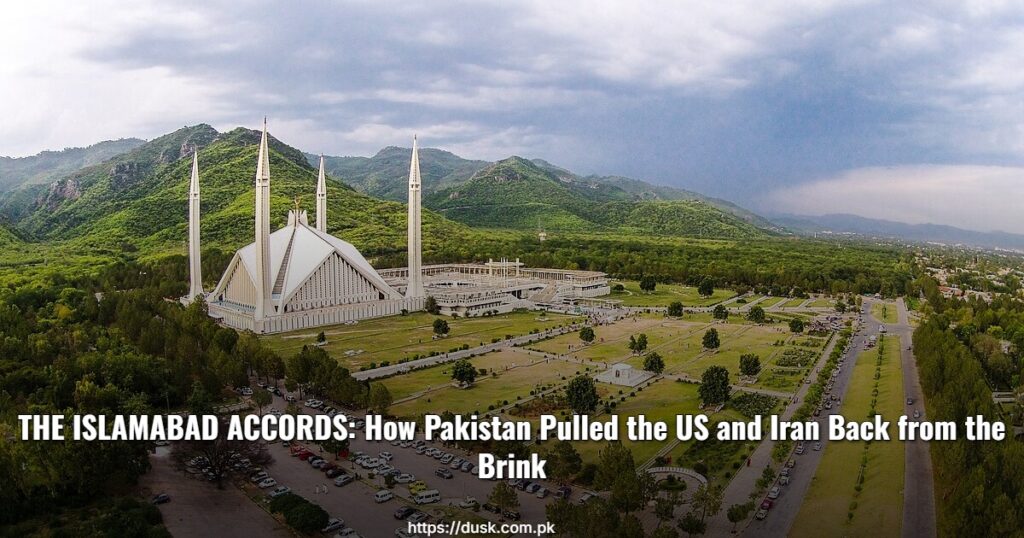
Islamabad Accords Full Terms: US-Iran Peace Deal Brokered by Pakistan | Exclusive
ISLAMABAD — For 40 days, the world held its breath. A war between the United States and Iran — sparked by the assassination of Supreme Leader Ayatollah Ali Khamenei on February 28 — had threatened to plunge the entire Middle East into chaos . Missiles flew over Gulf capitals. Oil prices surged past $115 a barrel. The Strait of Hormuz, through which 20 percent of the world’s crude passes, was effectively closed .
Then, against all odds, Pakistan stepped in.
On Saturday, April 10, 2026, US Vice President JD Vance will sit down across from Iranian Parliament Speaker Mohammad Bagher Ghalibaf in Islamabad to begin formal peace negotiations . The framework for these talks — now known as the “Islamabad Accords” — represents the most significant diplomatic breakthrough in the Middle East since the 2015 nuclear deal .
This is the inside story of the Islamabad Accords: the terms, the players, the high-wire diplomacy, and the fragile hope that this time, peace might actually hold.
The Backstory: How Pakistan Became the Unlikely Mediator
From Skepticism to Success: Defying the Doubters
In early March, as US and Israeli airstrikes pounded Iranian targets and Tehran retaliated with missile barrages across the Gulf, Pakistan’s offer to mediate was met with widespread skepticism . Analysts pointed to Pakistan’s own economic woes, its political instability, and its complex relationship with both Washington and Tehran. How could a country teetering on the brink of default broker peace between the world’s sole superpower and its most implacable adversary?
Yet Pakistan’s military and civilian leadership persisted. Prime Minister Shehbaz Sharif and Army Chief Field Marshal Asim Munir recognized an opportunity that others missed: Pakistan is one of the few nations with functional relationships with both the United States and Iran . While European allies refused to help Washington and Gulf states feared Iranian retaliation, Islamabad could talk to both sides without being dismissed by either.
“Pakistan achieved one of its biggest diplomatic wins in years,” South Asia expert Michael Kugelman wrote on X. “It also defied many skeptics and naysayers that didn’t think it had the capacity to pull off such a complex, high stakes feat” .
The Key Players: Sharif, Munir, and the All-Night Diplomacy
The breakthrough came after weeks of intensive backchannel communication. According to sources cited by Reuters, Munir held “all-night” phone calls with US Vice President JD Vance, Special Envoy Steve Witkoff, and Iranian Foreign Minister Abbas Araghchi . The discussions were coordinated through Oman, which had long served as a traditional mediator between Washington and Tehran, but it was Pakistan that ultimately secured the deal .
On April 5, President Donald Trump announced a two-week ceasefire, contingent on Iran’s agreement to reopen the Strait of Hormuz . “The US has already met and exceeded all of its military objectives,” Trump wrote on Truth Social, “and are very far along with a definitive Agreement concerning Longterm PEACE with Iran” .
Iranian Foreign Minister Abbas Araghchi confirmed Tehran’s agreement, posting on X: “If attacks against Iran are halted, our powerful armed forces will cease their defensive operations” . He added that safe passage through the Strait of Hormuz would be possible in coordination with Iran’s armed forces — a concession that would have been unthinkable just days earlier .
Prime Minister Shehbaz Sharif announced the breakthrough, declaring an “immediate ceasefire everywhere including Lebanon and elsewhere” that was “EFFECTIVE IMMEDIATELY” . He extended an invitation to both delegations to Islamabad for talks beginning April 10 .
The Framework: A Two-Phase Path to Peace
Phase One: Immediate Ceasefire and Strait of Hormuz Reopening
The Islamabad Accords are built on a two-phase framework designed to de-escalate tensions quickly while leaving room for complex negotiations on permanent peace .
Phase One, which went into effect on April 5, includes:
- Immediate cessation of hostilities between US and Iranian forces
- Reopening of the Strait of Hormuz to commercial shipping
- Suspension of US strikes on Iranian energy infrastructure
- Halt of Iranian missile and drone attacks on Gulf states
The reopening of the Strait of Hormuz is the centerpiece of the first phase. The waterway’s closure had triggered what the Gulf Times called “the worst energy supply shock in history,” sending oil prices above $115 per barrel and causing fuel shortages across South Asia and beyond . Within hours of the ceasefire announcement, oil prices collapsed below $95 per barrel, providing immediate relief to global markets .
Phase Two: The 45-Day Window for Permanent Peace
Phase Two is more ambitious — and more contentious. The framework provides a 45-day window for negotiators in Islamabad to reach a comprehensive peace agreement . This window can be extended by mutual consent, but the pressure is immense.
The final agreement is expected to address:
- Iran’s nuclear program — with potential curbs on enrichment in exchange for sanctions relief
- Unfreezing of Iranian assets — billions of dollars held abroad
- Regional security architecture — including the future of US military bases in the Gulf
- The status of Iran-backed proxies — including Hezbollah in Lebanon
The two-week ceasefire that began on April 5 was designed as a confidence-building measure — a “trial run” for a longer peace. If both sides adhere to the truce and make progress in Islamabad, the 45-day window could be extended. If not, the guns could resume firing.
Iran’s 10-Point Proposal: The Full Text
The Core Demands: From Hormuz Control to US Withdrawal
At the heart of the Islamabad negotiations is Iran’s 10-point peace plan, which Trump has described as “a workable basis” for talks . The proposal, first reported by Iran’s semi-official Mehr News Agency, represents Tehran’s opening position — and a significant shift from its previous maximalist demands .
The full 10-point plan includes:
- Controlled passage through the Strait of Hormuz — in coordination with Iranian armed forces, granting Iran a significant economic and geopolitical role
- An end to military action against all members of the “axis of resistance” — including Hezbollah in Lebanon
- Withdrawal of US combat forces from all bases and deployment points across the region
- Establishment of a secure transit protocol in the Strait of Hormuz that ensures Iran’s authority under agreed terms
- Full compensation to Iran for war damages — based on assessed estimates
- Lifting of all primary and secondary sanctions imposed on Iran
- Termination of all resolutions against Iran by the International Atomic Energy Agency’s Board of Governors
- Release of all Iranian assets and properties frozen abroad
- Ratification of all agreed measures through a binding United Nations Security Council resolution
- Recognition of Iran’s right to uranium enrichment for its nuclear programme — a clause included in the Farsi version of the plan but reportedly omitted from English versions shared with journalists
The Nuclear Clause: What’s in the Farsi Version
Point 10 is the most explosive — and the most contested. The Farsi version of Iran’s proposal explicitly includes “recognition of Iran’s right to uranium enrichment for its nuclear programme” . The English version shared with Western media reportedly omitted this clause, suggesting Tehran is aware of its Sensitivity.
For the United States, any acknowledgment of Iran’s “right to enrich” is a red line. Washington has long insisted that Iran must halt all enrichment activity as a precondition for sanctions relief. But with Iran now possessing enough highly enriched uranium for multiple weapons, according to intelligence assessments, the Biden and Trump administrations have been forced to confront a new reality .
The Lebanon Complication: Ceasefire Tied to Hezbollah
Point 2 introduces a complication that has frustrated US negotiators. Iran has demanded that any ceasefire include an end to Israeli military operations against Hezbollah in Lebanon . Vice President Vance has pushed back on this, stating that while the US has urged Israeli restraint, Lebanon was not part of the initial bilateral agreement struck between Washington and Tehran .
Prime Minister Sharif’s announcement of an “immediate ceasefire everywhere including Lebanon and elsewhere” suggests that Pakistan may have brokered a broader understanding . But Israel has not officially commented, and the extent of its commitment remains unclear.
The American Red Lines: What JD Vance Is Demanding
Non-Negotiable: End to Nuclear Enrichment
For the United States, the nuclear issue remains non-negotiable. According to sources familiar with the administration’s position, Washington is demanding:
- Total cessation of Iran’s nuclear enrichment — not merely a freeze
- Physical removal of “nuclear dust” from deeply buried facilities — a phrase Trump has used to describe the dismantlement of centrifuges and removal of enriched uranium
- Unrestricted IAEA access to all suspected nuclear sites
The US has signaled willingness to discuss comprehensive sanctions relief and the unfreezing of billions in Iranian assets, but only as part of a final Phase Two agreement .
Strait of Hormuz: ‘No Iranian Tolls or Military Interference’
On the Strait of Hormuz, Washington’s position is equally firm. While Trump has suggested a “joint venture” to manage the waterway, the US insists that traffic must resume without Iranian tolls or military interference . This directly conflicts with Iran’s demand for “controlled passage in coordination with Iranian armed forces” .
How Vance and Ghalibaf bridge this gap will determine whether the Islamabad talks succeed or fail.
The Saturday Summit: Who Is at the Table in Islamabad
The US Delegation: Vance, Kushner, Witkoff
The composition of the American delegation underscores the personal nature of Trump’s diplomacy. Rather than relying on traditional State Department channels, Trump has dispatched his most trusted inner circle :
- Vice President JD Vance — serving as the lead “interlocutor,” tasked with balancing hawkish rhetoric with the pragmatic need for peace
- Jared Kushner — Trump’s son-in-law and former White House adviser, who played a key role in the Abraham Accords
- Steve Witkoff — Trump’s special envoy and golfing partner, who has been involved in backchannel communications since the war began
The presence of these figures signals that the administration is treating the Islamabad talks as a deal-making opportunity rather than a traditional diplomatic negotiation.
The Iranian Delegation: Ghalibaf, Araghchi
Iran’s delegation is equally significant. The presence of Parliament Speaker Mohammad Bagher Ghalibaf — a former Revolutionary Guards commander — suggests that any deal reached in Islamabad will have the backing of Iran’s military and security establishment . Ghalibaf represents the pragmatic-conservative wing of the Iranian leadership that has gained domestic influence during the war.
Foreign Minister Abbas Araghchi, a seasoned diplomat who helped negotiate the 2015 nuclear deal, rounds out the Iranian team .
Pakistan’s Role: Host, Mediator, and Guarantor
Pakistan’s role extends beyond hospitality. Prime Minister Shehbaz Sharif and Army Chief Asim Munir will serve as mediators and, potentially, as guarantors of any agreement reached . The Pakistani military’s close ties to both Washington and Tehran make Islamabad uniquely positioned to enforce compliance.
The Global Reaction: World Leaders Praise Pakistan’s Diplomacy
Iran: ‘Complete Distrust’ but Willing to Talk
Iran’s National Security Council confirmed Tehran’s agreement to the talks but added a crucial caveat: Iran enters negotiations “with complete distrust of the American side” . The council also warned that Iran stood ready to respond with “full force” as soon as “the slightest mistake by the enemy is made” .
Foreign Minister Araghchi publicly thanked “my dear brothers HE Prime Minister of Pakistan Sharif and HE Field Marshal Munir for their tireless efforts to end the war in the region” .
United States: Trump Calls It a ‘Workable Basis’
President Trump has been uncharacteristically restrained in his public comments, calling Iran’s 10-point proposal “a workable basis on which to negotiate” . He has also taken credit for the breakthrough, noting that the US has “already met and exceeded” its military objectives .
Germany, Malaysia, UN: International Acclaim
International reaction has been swift and largely positive. German Chancellor Friedrich Merz “welcomed” the breakthrough and praised Pakistan’s role, emphasizing that “the immediate priority is to translate the temporary halt in fighting into a lasting peace settlement” .
Malaysian Prime Minister Anwar Ibrahim welcomed the “positive development” and praised Sharif for “tireless and courageous diplomacy” .
UN officials and regional powers expressed hope that the Islamabad talks would pave the way for a lasting agreement .
The Geopolitical Earthquake: Russia and China Left Watching
‘The Trap for the Kremlin Has Slammed Shut’
Perhaps the most significant geopolitical consequence of the Islamabad Accords is what it means for Russia. Moscow had been counting on a protracted US-Iran war to drain American resources and distract Washington from Ukraine .
Instead, the US and Iran are talking peace.
“The trap for the Kremlin has slammed shut,” wrote the Telegram channel “Socrates’ Sieve,” as quoted by Charter 97. “An ally largely betrayed by Putin, on whom Moscow had previously staked everything, has chosen a pragmatic peace, leaving the Kremlin as an outsider watching someone else’s success” .
The analysis continued: “Russia has experienced a loss of leverage, because Iran, which has begun a dialog with the United States, no longer needs Moscow as its only ‘lawyer’ and intelligence provider” .
Oil Prices Collapse Below $95 as Strait Reopens
The economic impact has been immediate. Brent crude, which had surged past $115 per barrel during the height of the war, collapsed below $95 following the ceasefire announcement . The return of Iranian oil to global markets threatens to end the streak of super-profits Russia had been enjoying from high energy prices .
“The economic effect of the truce was immediate,” the analysis noted. “For Russia’s budget, which is designed to meet the conditions of military inflation and high energy prices, such a signal means an inevitable sequestration of expenditures” .
China, which had supported diplomatic efforts but remained publicly neutral, has not issued an official response .
The Risks: What Could Still Go Wrong
The Trust Deficit: ‘Complete Distrust’ on Both Sides
The single greatest obstacle to the Islamabad Accords is the profound lack of trust between Washington and Tehran. Iran enters the talks “with complete distrust of the American side” . The United States, for its part, views Iran’s nuclear program and regional proxies with deep skepticism.
“The gap of distrust is humongous between the United States and Iran,” James Dorsey, a senior fellow at Singapore’s S. Rajaratnam School of International Studies, told The Japan Times in March. “And that complicates discussions” .
The Israel Factor: Netanyahu’s Unspoken Objections
Israel has not officially commented on the Islamabad Accords, but Prime Minister Benjamin Netanyahu is known to oppose any deal that leaves Iran’s nuclear infrastructure intact. Israeli strikes have destroyed an estimated 70% of Iran’s steel production capacity, according to Netanyahu, and the Israeli leader has vowed to continue “crushing” the country .
If Netanyahu believes the Islamabad Accords let Iran off the hook, Israel could take unilateral military action — potentially derailing the entire peace process.
The Hard-Liner Problem: Ghalibaf’s Domestic Constraints
Ghalibaf may be a pragmatist, but he answers to Iran’s hard-line supreme leader, Mojtaba Khamenei. The younger Khamenei has reportedly rejected earlier diplomatic overtures, telling officials that “now is not the time for peace” until the US and Israel “are forced to surrender, admit defeat and pay compensation” .
If Ghalibaf returns to Tehran with a deal that hard-liners view as too concessionary, he could be overruled — or worse, purged.
A Fragile Hope
The Islamabad Accords are not a peace treaty — not yet. They are a framework, a starting point, a fragile pause in a war that has already claimed thousands of lives and displaced millions. The talks that begin on Saturday will determine whether that pause becomes permanent or whether the region plunges back into conflict.
But for the first time in more than 40 days, there is reason for hope. Pakistan has done what no other nation could: brought the United States and Iran to the same table. The world is watching.
“Pakistan achieved one of its biggest diplomatic wins in years,” Michael Kugelman wrote. “It also defied many skeptics and naysayers” .
Now comes the hard part.
Join Dusk on WhatsApp
Get the latest news, videos and blogs straight to your phone.
Join Now