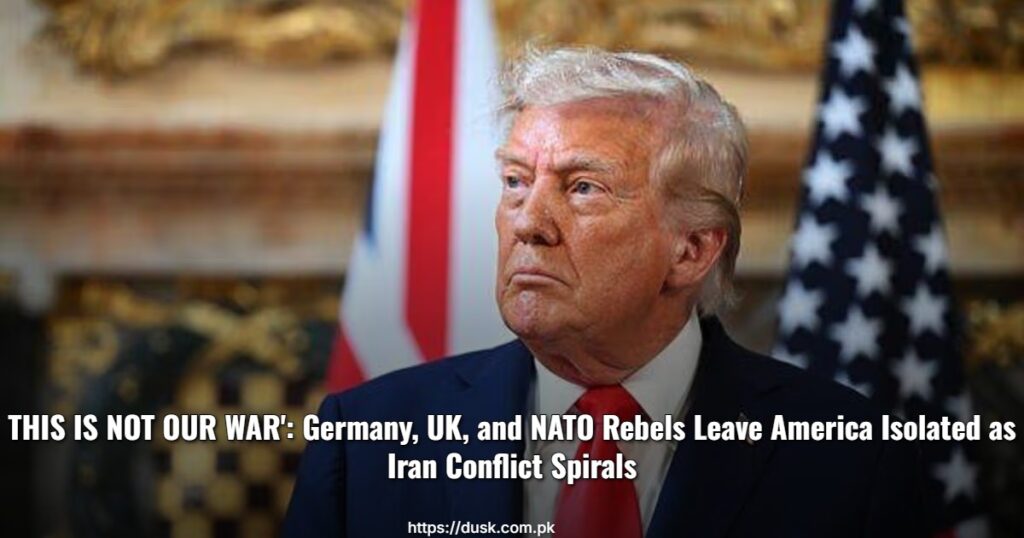
Why US Allies Refuse to Help in Iran War: Germany, UK, NATO Reject Trump’s Pleas | Exclusive
President Donald Trump is begging for help. He has called European leaders, pressed Gulf monarchs, and publicly threatened NATO with a “very bad future” if allies refuse to join his war against Iran . The response has been a wall of rejection so uniform, so emphatic, that it amounts to a diplomatic earthquake.
Germany says “this is not our war.” Britain insists it “will not be drawn in.” France keeps its navy in the eastern Mediterranean, far from the fight. Spain refuses access to its military bases. Poland rules out sending forces. Gulf states, battered by Iranian missiles, are quietly telling Washington they cannot join a conflict with a neighbor they must live beside for generations .
Only one nation is even “considering” helping .
This is the inside story of America’s coalition of one — why traditional allies are walking away, what it means for the war, and whether the transatlantic alliance can survive the strain.
The Diplomatic Earthquake: Trump’s Pleas Fall on Deaf Ears
“What Does Trump Expect a Handful of European Frigates to Do?”
The crisis began in earnest on March 15, 2026, when Trump went public with his frustration. Speaking to reporters aboard Air Force One, he warned that countries benefiting from Gulf oil exports should contribute to securing the Strait of Hormuz — and that failure to help would be “very bad for the future of NATO” .
Behind the scenes, the diplomatic pressure was even more intense. According to military intelligence sources cited by Iranian media, Trump personally called multiple European and Southeast Asian leaders, expressing displeasure at their refusal. He demanded warships, radar systems, and direct participation in intercepting Iranian missiles.
The response was swift and devastating.
German Defense Minister Boris Pistorius delivered the most cutting rebuke: “What does Trump expect a handful of European frigates to do that the powerful U.S. Navy cannot?” . The question hung in the air, unanswered, because it exposed the fundamental absurdity of Washington’s position. If the United States — with the world’s most powerful navy — cannot force the Strait of Hormuz open, what can three German frigates accomplish?
The Only Country ‘Considering’ Help — And Why It Matters
According to a military insider speaking to Iran’s Press TV, three nations “categorically rejected” Trump’s demands. Only one leader, facing domestic political pressure, agreed to “consider” helping .
Western intelligence sources have not named the country, but analysts point to several possibilities: perhaps a smaller Gulf state with less to fear from Iran, or a NATO member with unique strategic dependencies on Washington. The fact that even this potential helper faces domestic opposition underscores how politically toxic the war has become.
Germany: The Loudest ‘No’
Pistorius and Merz Draw the Line
Germany’s rejection has been the most emphatic, the most quotable, and the most damaging to Trump’s prestige.
Defense Minister Boris Pistorius did not mince words on March 16: “This is not our war, and we didn’t start it” . He noted that “neither the United States nor Israel consulted us before the war,” and that Washington explicitly stated at the outset that European assistance was “neither necessary nor desired” .
Chancellor Friedrich Merz’s spokesman, Stefan Kornelius, reinforced the message: “NATO is an alliance for the defence of territory” and “the mandate to deploy NATO is lacking” in the current situation .
“This Is Not Our War, and We Didn’t Start It”
The phrase has become the unofficial motto of European refusal. It captures three core sentiments:
- Lack of consultation: Allies were not informed, let alone asked, before the US-Israeli strikes that killed Iran’s Supreme Leader and triggered the war.
- Lack of ownership: Europeans do not see this as their conflict. It was America’s choice, and America must bear the consequences.
- Lack of moral obligation: Without a direct threat to European territory, there is no Article 5 trigger and no alliance obligation.
Pistorius also questioned the practical value of European involvement. “Sending more warships to the region will likely not help achieve” diplomatic solutions, he said . Germany, he added, remains focused on its primary responsibilities: defending NATO’s eastern flank and the Arctic region .
Britain’s Starmer: ‘We Will Not Be Drawn In’
The ‘Oldest Ally’ Rebukes Trump
If Germany’s rejection stung, Britain’s was devastating. The “special relationship” has been the bedrock of American foreign policy for generations. But Prime Minister Keir Starmer has drawn a red line.
“We will not be drawn into the wider war with Iran,” Starmer declared at a news conference on March 16 . He added that British troops should only be sent into action that is legal and has “a proper thought-through plan” — an implicit criticism of what London views as Washington’s rushed escalation .
Trump, visibly irritated, rated Starmer a mere “eight out of ten” and complained that Britain should be involved “enthusiastically” . But Starmer’s position reflects deep skepticism in London. British officials remember the Iraq War’s faulty intelligence and disastrous consequences. They are not eager to repeat the mistake.
NATO’s Founding Treaty: Designed for Defense, Not Wars of Choice
Lord Nick Carter, Britain’s former chief of the defense staff, articulated the legal argument against involvement. NATO was created as “a defensive alliance, and all of its articles are essentially oriented towards the defense,” he told the BBC. “It was not an alliance that was designed for one of the allies to go on a war of choice and then oblige everybody else to follow” .
Starmer himself emphasized that a NATO mission in the Strait of Hormuz “won’t be and it’s never been envisioned” . This is not alliance business.
France, Spain, Poland, Italy: The European Wall of Rejection
Macron’s ‘Eight Out of Ten’ — and What It Really Means
President Emmanuel Macron has maintained warmer personal relations with Trump than most European leaders. Trump rated him “an eight” on engagement . But warmth has not translated into military commitment.
The French foreign ministry posted on social media that its navy was staying in the eastern Mediterranean: “Posture has not changed: defensive it is” . France’s aircraft carrier and accompanying warships remain far from the Strait of Hormuz, signaling Paris’s determination to avoid entanglement.
Spain Refuses Base Access, Poland Rules Out Forces
Spain has gone further than most. Prime Minister Pedro Sánchez has not only refused to send forces but has denied the United States access to Spanish military bases for strikes against Iran . Trump, reportedly furious, has threatened to cut trade ties with Madrid.
Polish Foreign Minister Radoslaw Sikorski said Polish leaders had “ruled out” sending forces into the conflict . He added a pointed observation about Trump’s rhetoric: “It’s a bit worrying that President Trump refers to NATO as ‘them’ or ‘Europe’ rather than ‘us'” .
Italian Foreign Minister Antonio Tajani downplayed expectations that Italy’s navy would be drawn into Hormuz. “We are not involved in military operations in the Strait of Hormuz,” he said. Italy “never said — but neither did France, no other European country has offered to send military ships to force a passage” .
NATO’s Existential Crisis: ‘Not NATO’s War’
Rutte Rules Out Article 5
The strain on NATO has been immense. Early in the conflict, Turkey — a NATO member — shot down an Iranian ballistic missile heading toward its airspace . The incident raised fears that the alliance could be dragged into war through Article 5, the collective defense clause.
But NATO Secretary General Mark Rutte quickly shut that down. “Article 5 I think is not in order here, and nobody’s talking about Article 5,” he told Reuters . While he expressed support for the US and Israel, he made clear the alliance would not be invoked.
The Alliance’s Founding Purpose vs. Trump’s Demands
The deeper problem is structural. NATO was created to defend member territory, not to fight wars of choice initiated by individual members outside Europe. As German Chancellor Merz’s spokesman put it, “NATO is a defensive alliance, not an interventionist one” .
Trump’s demand that NATO help reopen the Strait of Hormuz fundamentally misunderstands — or chooses to ignore — what the alliance is for. European leaders are not merely being difficult; they are adhering to the legal and political constraints of the treaty.
The Gulf Allies: Neighbors First, Allies Second
“Iran Will Remain Our Neighbor Long After America Leaves”
If European rejection is diplomatically painful, Gulf Arab reluctance is strategically devastating. These are the nations most directly affected by Iran’s closure of the Strait of Hormuz. Their economies depend on oil exports through the waterway. Yet they are sitting on the sidelines.
The reason, as one UAE official told CNN, is simple geography: “At the end of the day, you are neighbors” . Relations with Tehran will eventually have to normalize, even if it takes decades to rebuild trust. American forces, as Kuwait University professor Bader Al Saif noted, will eventually “pack up and leave” the Middle East. Iran will remain .
UAE, Saudi Arabia Walk a Tightrope
The UAE has been particularly careful. After unconfirmed reports that it might have struck an Iranian desalination plant — potentially its first offensive action of the war — Abu Dhabi issued swift denials. Presidential adviser Anwar Gargash said the UAE would “not be dragged into escalation” .
Saudi Arabia faces even more complex pressures. The kingdom has a Red Sea coastline, offering an export route that bypasses Hormuz. But that route runs past Yemen, where Iran-backed Houthi rebels have demonstrated their ability to attack shipping. Entering the war could force Riyadh to fight on multiple fronts .
The Houthi Factor: Yemen’s Rebels as Iran’s Deterrent
The Houthis are Iran’s most unpredictable proxy. During the 2023-2024 Gaza war, they attacked more than 100 vessels in the Red Sea. They still hold the Galaxy Leader and its 25 crew members hostage after nearly two and a half years.
For Gulf states, the Houthi threat is a powerful deterrent. If they join the war against Iran, they risk activating a proxy on their southern border that can disrupt Red Sea shipping and strike Saudi territory.
Desalination Plants Under Attack: The Vulnerability Gulf States Fear Most
Perhaps the most terrifying vulnerability for Gulf states is water. The desert nations have less than 1% of the world’s population but account for roughly half its desalination capacity . They depend almost entirely on desalinated water for survival.
Early in the conflict, Iran retaliated against a strike on its Qeshm Island desalination facility by damaging a desalination plant in Bahrain with a drone . The message was unmistakable: if you target our water, we will target yours. For Gulf leaders, that threat is existential.
The Only Exception: One Country ‘Considers’ Helping
Intelligence Sources Reveal Secret Discussions
According to the military insider quoted by Iran’s Press TV, one nation has not slammed the door entirely. Under domestic political pressure and facing party dynamics, its leader has agreed to “consider” Trump’s request .
Analysts speculate about the identity. Perhaps it is a smaller Gulf state like Bahrain, home to the US Fifth Fleet, that feels it has no choice. Perhaps it is a European nation with unique strategic dependencies. Or perhaps it is an Asian ally like Japan, which imports 95% of its oil from the Middle East and has already begun releasing strategic reserves .
Domestic Politics and Regional Rivalries
If the country is in the Gulf, its calculus would involve both fear of Iran and rivalry with neighbors. Smaller states sometimes see advantage in aligning closely with Washington, even at the risk of Iranian retaliation. But the political costs are steep, and any commitment would likely be limited and discreet.
Why They’re Refusing: The 5 Root Causes
1. Iraq Syndrome: The 2003 Trauma That Never Healed
European leaders remember the Iraq War. They remember faulty intelligence, the absence of weapons of mass destruction, the destabilization of the region, and the years of chaos that followed. They are not eager to repeat those mistakes .
2. No Consultation, No Buy-In: “They Didn’t Even Ask Us”
Germany’s Pistorius emphasized that “neither the United States nor Israel consulted us before the war” . When Washington initially said European help was unnecessary, it alienated potential partners. Now that help is needed, those partners feel no obligation to provide it.
3. The Iran Neighbor Problem: Geography Is Forever
For Gulf states, this is the decisive factor. Iran is a permanent neighbor. America is a temporary guest. Gulf leaders must calculate how to live beside Iran long after the war ends .
4. NATO’s Legal Limits: Designed to Defend, Not Offend
NATO’s founding treaty does not obligate members to join wars of choice initiated by individual allies. As multiple European leaders have noted, the alliance is for defense, not offense .
5. Trump’s Transatlantic War: Years of Alienation Boil Over
Trump has spent years demeaning European allies, demanding more defense spending, and questioning NATO’s value. Now that he needs their help, the accumulated resentment has come due. As The New Republic observed, “Begging them to cobble together some kind of ‘save the oil’ coalition at the last minute seems like a hail mary in every sense” .
The Consequences: America Fights Alone
Strait of Hormuz Closed, Oil at $100
The practical consequences of allied refusal are already visible. Iran has effectively closed the Strait of Hormuz, through which about 20% of global oil passes . Oil prices have surged 40-50%, hovering near $100 per barrel .
Air Defense Missiles Running Low
According to military sources cited by Iranian media, US air defense missile stocks in the Middle East are “severely depleted.” The Pentagon is scrambling to move weapons from other regions to replenish supplies .
Treasury Secretary Admits Defeat: ‘We’re Fine With Iranian Oil Flowing’
Perhaps most embarrassing, Treasury Secretary Scott Bessent admitted on March 16 that the United States is “fine” with allowing Iranian oil tankers to pass through the Strait of Hormuz . “The Iranian ships have been getting out already, and we’ve let that happen to supply the rest of the world,” he said.
The admission was stunning: after launching a war partly justified by the need to stop Iranian oil exports, Washington is now quietly permitting those exports to continue because it cannot afford the economic consequences of a full blockade.
The End of the American-Led Order?
“This Is Different from Afghanistan and Iraq”
In Afghanistan and Iraq, the United States assembled coalitions — sometimes grudgingly, sometimes with difficulty, but coalitions nonetheless. Today, America stands virtually alone. The difference is not merely quantitative but qualitative. It signals a fundamental erosion of trust in American leadership.
What Happens When the World’s Sole Superpower Has No Friends
The long-term implications are profound. If the United States cannot rely on allies in a major conflict, its ability to project power, enforce norms, and maintain global order is severely diminished. Adversaries like Russia and China are watching. Dmitry Medvedev, the Kremlin official, mocked Trump’s predicament with evident glee: “First, the US kills Iran’s leader and starts a war in the Middle East. Next, NATO idiots… mull invoking Article 5” .
The erosion of alliances does not just affect this war. It affects every future conflict, every diplomatic negotiation, every moment when the United States needs friends.
The Coalition of One
America went to war against Iran with Israel at its side and little else. No European allies. No Gulf partners. No NATO mandate. No UN resolution. No coalition of the willing.
Three weeks in, with oil prices surging, missiles running low, and the Strait of Hormuz closed, Washington is scrambling to assemble the support it spurned at the outset. But allies are not rushing to help a partner that ignored them when the shooting started and now demands their ships, their soldiers, and their treasure.
“This is not our war,” Germany says.
“We will not be drawn in,” Britain insists.
“Iran will remain our neighbor,” Gulf states explain.
The United States fights alone. And in the lonely business of war, that is the most dangerous place to be.
Join Dusk on WhatsApp
Get the latest news, videos and blogs straight to your phone.
Join Now