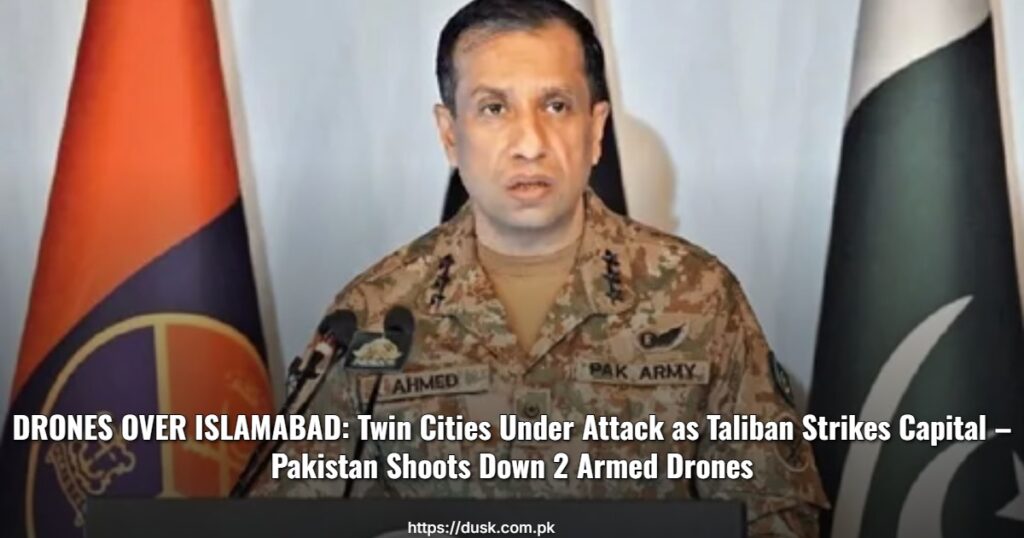
Drone Attack on Islamabad and Rawalpindi: Full Coverage of March 13, 2026 Incident
RAWALPINDI/ISLAMABAD, Pakistan – March 14, 2026 – In a dramatic escalation of cross-border tensions, security forces intercepted and shot down two armed drones targeting the twin cities of Rawalpindi and Islamabad on Friday evening, sending shockwaves through the federal capital and temporarily grounding flights at Islamabad International Airport.
This comprehensive article provides real-time updates, official statements, casualty reports, and expert analysis of the unprecedented drone incursion that has pushed Pakistan-Afghanistan relations to the brink of open conflict.
Drone Attack on Islamabad and Rawalpindi
| Category | Details |
|---|---|
| Incident Date | March 13, 2026 (evening) |
| Location | Faizabad Interchange (Rawalpindi/Islamabad border), I-9 Sector (Islamabad) |
| Attack Type | Armed drone incursion / loitering munitions |
| Interception Method | Electronic countermeasures and anti-drone technology |
| Casualties | None confirmed (official); minor injuries reported unofficially |
| Property Damage | Minor damage from debris; shattered windows in I-8 sector |
| Airport Impact | Islamabad International Airport – temporary suspension of flight operations |
| Claimed Responsibility | Afghan Taliban Ministry of Defence |
| Pakistan’s Response | Strong condemnation; diplomatic protest; heightened security alerts |
Breaking News: Twin Cities Under Drone Threat
Security forces successfully intercepted two drones that entered Pakistani airspace near the sensitive Faizabad Interchange—the critical junction connecting Rawalpindi and Islamabad—on Friday evening, March 13, 2026.
According to official security sources, the drones were detected by advanced radar systems while still at a distance, allowing security personnel to deploy electronic countermeasures and anti-drone technology that jammed their signals and forced both unmanned aerial vehicles to crash before reaching any strategic targets.
One drone fell near the heavily trafficked Faizabad Interchange, while the second crashed in Islamabad’s I-9 industrial sector. Initial reports also suggest that debris from the downed drones may have caused some damage in the adjacent I-8 sector, where residents reported loud explosions and shattered windows.
Flight Operations Disrupted
The Federal Civil Aviation Authority took immediate precautionary measures, temporarily suspending all flight operations at Islamabad International Airport for approximately two hours. Passengers reported delays and confusion as flights were held at departure gates or diverted to alternate airports. Normal operations resumed after security forces confirmed the airspace was clear of threats.
Official Statements: What Pakistan Government Says
Ministry of Information Confirms Interception
The Pakistan Ministry of Information released an official statement confirming the successful neutralization of the drone threat:
“On the evening of March 13, 2026, two drones were detected in areas adjacent to Rawalpindi. Security forces swiftly responded using advanced anti-drone technology, jamming their signals and forcing them to crash. No military or other infrastructure was hit. There are no casualties, and only minor damage has been reported from the debris of the downed drones.”
The statement urged citizens to rely on official channels for information and avoid spreading unverified reports on social media.
Prime Minister Shehbaz Sharif’s Response
Prime Minister Shehbaz Sharif, currently on a crucial visit to Saudi Arabia for defense consultations, was immediately briefed on the incident. According to PM Office sources, the Prime Minister directed security agencies to maintain the highest state of alert and take all necessary measures to protect the country’s sovereignty.
Inter-Services Public Relations (ISPR) Statement
The military’s media wing, ISPR, released a brief statement confirming the interception and praising the swift response of security forces. “Pakistan’s armed forces remain fully capable of defending the motherland against any aggression. The nation stands united against all threats,” the statement read.
Taliban Claims Responsibility: Analyzing the Afghan Connection
Afghan Ministry of Defence Statement
In a dramatic development, the Afghan Taliban’s Ministry of Defence posted on its official X (formerly Twitter) account, claiming responsibility for what it described as “retaliatory drone strikes” targeting a “key Pakistani military center” in Islamabad.
The Taliban statement asserted that their forces had successfully conducted the operation, causing “significant human and material losses”—a claim vehemently rejected by Pakistani authorities.
Pakistan Rejects Taliban Claims
Pakistan’s Ministry of Information swiftly dismissed the Taliban’s claims as “baseless propaganda” and part of a pattern of “fake news” emanating from official Afghan Taliban accounts.
“There is no verifiable evidence to support the Taliban regime’s assertions,” the ministry stated. “This is part of a systematic campaign of misinformation designed to mask the fact that the Taliban regime continues to harbour and support multiple terrorist organisations hostile to Pakistan.”
Why Now?
The drone incident represents the latest and most serious escalation in rapidly deteriorating Pakistan-Afghanistan relations:
March 12, 2026 – Pakistan Air Force conducted airstrikes inside Afghanistan, targeting what Islamabad described as militant hideouts. Taliban officials claimed these strikes hit locations in Kabul, Kandahar, Paktia, and Paktika provinces, resulting in civilian casualties.
March 13, 2026 (Morning) – Afghanistan’s Defence Ministry claimed responsibility for separate drone strikes on Pakistani military installations in Kohat district, Khyber Pakhtunkhwa.
March 13, 2026 (Evening) – Islamabad/Rawalpindi drone incursion.
The Taliban framed both the Kohat and Islamabad attacks as direct retaliation for Pakistan’s cross-border airstrikes.
Location Analysis: Why Faizabad and I-9/I-8 Matter
Strategic Significance
The choice of target areas raises serious concerns about the sophistication of the attackers’ intelligence and targeting capabilities:
Faizabad Interchange – This major traffic intersection serves as the gateway between Rawalpindi and Islamabad. It is adjacent to multiple sensitive installations, including military establishments and diplomatic enclaves. The area experiences heavy civilian traffic throughout the day and evening.
I-9 Sector, Islamabad – An industrial area housing commercial enterprises, warehouses, and light manufacturing. While not primarily residential, its proximity to other sectors makes it a significant urban location.
I-8 Sector, Islamabad – A densely populated residential sector where unconfirmed reports suggest debris may have caused damage. Residents reported hearing loud explosions and finding shattered windows, though authorities have not officially confirmed these details.
Civilian Impact Assessment
Security officials emphasize that the drones were intercepted before reaching their apparent targets, minimizing civilian casualties and damage. However, the psychological impact on residents of the twin cities has been significant, with many expressing anxiety about the unprecedented nature of the attack.
Pakistan’s Defense Response: Anti-Drone Capabilities Explained
How Pakistan Intercepted the Drones
Security sources confirm that Pakistan employed advanced electronic warfare capabilities to neutralize the drone threat:
Signal Jamming – Electronic countermeasures disrupted the communication links between the drones and their operators, causing loss of control.
GPS Spoofing – Advanced systems may have been used to confuse the drones’ navigation systems, forcing them off course.
Forced Crash Landing – With control links severed and navigation compromised, both drones were forced to crash in open or less-sensitive areas.
Pakistan’s Anti-Drone Arsenal
Pakistan has invested significantly in counter-unmanned aerial systems (C-UAS) in recent years, particularly after previous drone incidents along the western border. These capabilities include:
- Radar systems specifically calibrated to detect small, low-flying drones
- Electronic jammers capable of disrupting various communication frequencies
- Directed energy weapons (laser systems) for drone neutralization (in advanced stages)
- Traditional air defense systems as backup.
Security Alert Status
Following the incident, security forces across the twin cities and throughout the country have been placed on high alert. Additional checkpoints have been established, and aerial surveillance has been intensified.
International Reaction: Global Community Watches Closely
United Nations
The United Nations Secretary-General’s office issued a statement expressing concern over escalating cross-border hostilities and urging both Pakistan and Afghanistan to exercise maximum restraint.
United States
State Department spokesperson Matthew Miller stated: “The United States is closely monitoring the situation. We call on all parties to avoid escalation and respect each other’s sovereignty. Our commitment to regional stability remains unwavering.”
China
China’s Foreign Ministry expressed concern over the deteriorating security situation and offered to facilitate dialogue between the two neighbors.
Saudi Arabia
Given Prime Minister Shehbaz Sharif’s presence in the kingdom for defense consultations, Saudi officials are understood to be closely monitoring developments and offering diplomatic support to de-escalate tensions.
India
The Indian Ministry of External Affairs issued a brief statement saying it was “watching the situation carefully” while emphasizing the importance of regional stability.
Expert Analysis: What This Means for Pakistan’s Security
Dr. Ayesha Siddiqa – Security Analyst
“The use of drones to target the twin cities represents a qualitative escalation in the threat Pakistan faces from non-state actors and hostile neighboring entities. That the drones reached as far as Islamabad before interception raises serious questions about gaps in Pakistan’s air defense coverage. The government must urgently review and enhance its perimeter security.”
Lt. Gen. (Retd) Amjad Shoaib – Defense Analyst
“This was a test of Pakistan’s air defense capabilities, and thankfully, our forces responded effectively. However, we cannot afford complacency. The perpetrators must be identified and held accountable. Pakistan has every right to respond proportionately to protect its sovereignty.”
Imtiaz Gul – Security Expert
“The Taliban’s claim of responsibility, even if exaggerated, signals a dangerous new phase in Pakistan-Afghanistan relations. When a neighboring government openly claims attacks on your capital city, traditional diplomatic norms have collapsed. Pakistan must carefully calibrate its response to avoid being drawn into a prolonged conflict while demonstrating that such attacks will not be tolerated.”
Drones and Pakistan’s Security Challenges
Previous Drone Incidents
While Pakistan has faced drone threats before, particularly along the Afghanistan border and in Balochistan, this marks the first confirmed instance of drones reaching the Islamabad-Rawalpindi area:
| Date | Location | Incident |
|---|---|---|
| March 2025 | North Waziristan | Drone spotted near border area; forced to land |
| September 2024 | Chaman Border | Cross-border drone fired at security post |
| January 2024 | Gwadar | Suspected surveillance drone intercepted |
| March 2026 | Islamabad/Rawalpindi | Armed drones shot down |
Evolution of Threat
Security analysts note that the drone threat has evolved significantly:
- From surveillance drones to armed munitions
- From border areas to major urban centers
- From isolated incidents to coordinated operations
What Happens Next: Possible Scenarios
Diplomatic Escalation
Pakistan may pursue diplomatic channels, lodging formal protests with the Afghan Taliban government and seeking international condemnation of the attack. Given the Taliban’s control of Afghanistan, meaningful diplomatic pressure requires regional and international cooperation.
Military Response
Pakistan may conduct retaliatory strikes against militant infrastructure in Afghanistan, particularly targeting groups it accuses of being harbored by the Taliban regime. This would mirror previous patterns but carries risks of further escalation.
Enhanced Security Measures
Domestically, Pakistan will likely:
- Strengthen air defense coverage around major cities
- Accelerate acquisition of advanced anti-drone systems
- Enhance intelligence coordination to preempt future attacks
- Increase security at sensitive installations
International Mediation
Given the dangerous trajectory of Pakistan-Afghanistan relations, regional powers (China, Saudi Arabia) or international bodies (UN, OIC) may attempt mediation to prevent full-scale conflict.
Practical Information for Residents
Safety Guidelines
In light of the heightened threat, residents of Islamabad and Rawalpindi are advised:
DO:
- Stay informed through official government channels
- Report suspicious activity to law enforcement (Helpline: 15)
- Follow instructions from security personnel at checkpoints
- Keep emergency contacts readily available
DON’T:
- Spread unverified information on social media
- Approach suspicious objects or debris
- Congregate at incident sites, hampering security operations
- Share sensitive security-related information publicly
Flight Information
Passengers traveling through Islamabad International Airport are advised to:
- Check with airlines for updated flight schedules
- Arrive early to accommodate enhanced security screening
- Monitor Civil Aviation Authority announcements
Join Dusk on WhatsApp
Get the latest news, videos and blogs straight to your phone.
Join Now