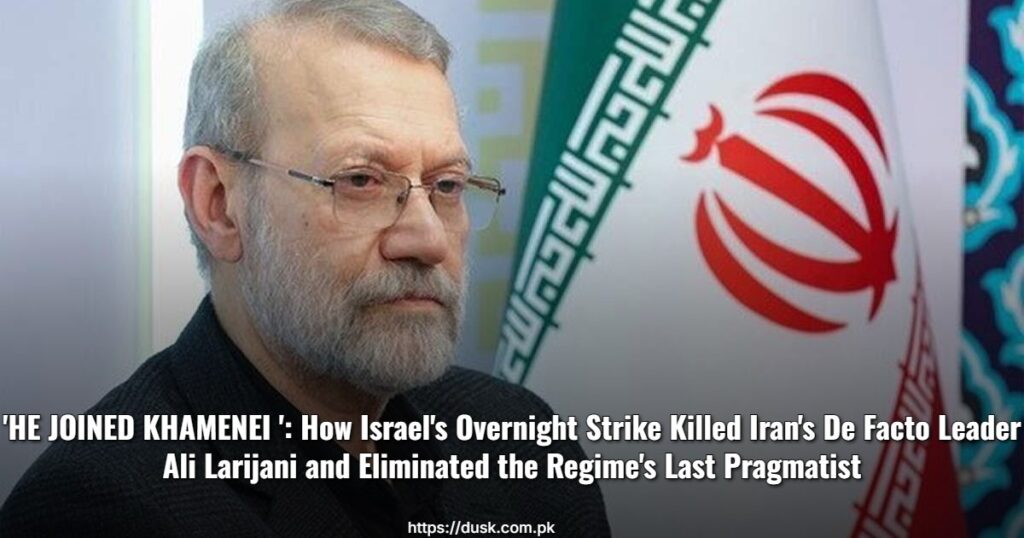
The Killing: What We Know About the Strike That Took Out Iran’s Wartime Leader
The Announcement: Israel’s Defense Minister Delivers Blunt Message
The news broke through Israeli Defense Minister Israel Katz on Tuesday morning. In a statement that blended military precision with theological condemnation, Katz announced that Larijani had been “eliminated last night” alongside Gholamreza Soleimani, the commander of Iran’s Basij paramilitary force .
Prime Minister Benjamin Netanyahu’s office released a photograph of the premier on the phone, captioned: “Prime Minister Benjamin Netanyahu orders the elimination of senior figures in the Iranian regime” . The message was unmistakable: these killings were deliberate, authorized at the highest level, and intended to send a signal that no Iranian leader is safe.
The Target: A Hideout Apartment in Tehran
According to Israeli media reports, Larijani was not struck in an official government building or military headquarters. He was killed in a “hideout apartment” in northern Tehran, where he had been staying with his son to evade Israeli intelligence .
The choice of target location speaks volumes about the intelligence war raging beneath the visible conflict. Israel’s Mossad has penetrated Iran’s security apparatus so deeply that it can track the movements of the country’s most protected official, identify when he moves to a secure location, and coordinate an airstrike that reduces that location to rubble .
The Second Strike: Basij Commander Gholamreza Soleimani Also Killed
The operation was a double-tap. Simultaneously, Israeli aircraft struck a “makeshift tent area” where Gholamreza Soleimani, the 61-year-old commander of the Basij militia, was hiding with his deputy, Seyyed Karishi . The IDF stated that Soleimani had deliberately avoided known headquarters, setting up temporary quarters to make tracking more difficult. Israeli intelligence found him anyway .
The Man Who Ran Iran: Who Was Ali Larijani?
From Revolutionary Guard to Khamenei’s Right Hand
Ali Larijani was born in Najaf, Iraq, in 1957 to a prominent Shia cleric family close to Ayatollah Ruhollah Khomeini . He joined the Islamic Revolutionary Guard Corps during the Iran-Iraq War of the 1980s, fighting in the trenches before transitioning to political roles .
His rise through Iran’s complex power structure was methodical: head of state broadcaster IRIB for a decade starting in 1994, security adviser to Khamenei from 2004, chief nuclear negotiator from 2005 to 2007, and Speaker of Parliament for an unprecedented 12 years from 2008 to 2020 .
In August 2025, President Massoud Pezeshkian appointed Larijani secretary of the Supreme National Security Council, returning him to the center of power just months before the war erupted .
The ‘Kennedys of Iran’: A Political Dynasty
Time magazine famously dubbed the Larijani family the “Kennedys of Iran” in 2009, recognizing their dominance across the Islamic Republic’s key institutions . Ali’s brother Sadeq is an ayatollah who served as head of the judiciary. Another brother, Fazel, held diplomatic posts. The family’s reach extended through marriage as well: Ali wed Farideh Motahari, daughter of Morteza Motahhari, a key ideologue of the 1979 revolution .
This dynastic background gave Larijani something no other official possessed: the ability to operate across factional lines, trusted by hard-liners for his IRGC credentials and by pragmatists for his diplomatic flexibility .
The Philosopher-Warrior: Scholar, Negotiator, and Enforcer
Larijani was an unusual figure in Iran’s leadership. He held a doctorate in Western philosophy from the University of Tehran, writing extensively on Immanuel Kant . He was as comfortable discussing German idealism as he was ordering the suppression of protests.
This duality defined his career. He led the brutal crackdown on anti-regime protests in January 2026, in which human rights activists say at least 6,508 protesters were killed and 53,000 arrested . Yet he was also the architect of the 2015 nuclear deal, the Joint Comprehensive Plan of Action, which he shepherded through parliament .
“He is a true insider, a canny operator, familiar with how the system operates,” Ali Vaez of the International Crisis Group said before the war .
The Succession Plan: How Larijani Became Iran’s De Facto Leader
Khamenei’s Secret Directive: The Survival Playbook
Before the war began, Supreme Leader Ayatollah Ali Khamenei reportedly tasked Larijani with a secret mission: devise a plan to ensure the Islamic Republic would survive a decapitation strike by the United States and Israel . Larijani prepared a “mosaic defense” network and protocols for leadership continuity should the supreme leader be killed .
When death came for Khamenei, Larijani executed the playbook.
February 28: The Day the Supreme Leader Died
On February 28, 2026, Israeli and US airstrikes killed Ayatollah Ali Khamenei in his central Tehran compound . Hours later, as Tomahawk missiles continued to rain down, Larijani appeared on national television.
“The Americans and the Zionists have burned the heart of the Iranian people,” he declared. “And we will burn their hearts. They should know it’s not like they can strike and leave” .
That appearance marked the beginning of Larijani’s tenure as Iran’s de facto wartime leader.
Larijani Takes the Reins: From Backroom Operator to Public Face
While Khamenei’s son Mojtaba was formally chosen as the new supreme leader, he has not been seen in public since the strike that killed his father . Reports suggest he was injured in the same attack .
Larijani filled the void. He coordinated ballistic missile deployments along the Gulf coast. He oversaw the defense of nuclear sites. He greenlit strikes against American and Israeli targets . And he became the public face of Iranian defiance, regularly responding to President Trump on social media and appearing at public rallies .
The Pragmatist’s Dilemma: Why Larijani’s Death Changes Everything
The Moderate Who Lost: Larijani’s Opposition to Mojtaba Khamenei
Behind the scenes, Larijani fought a losing political battle. According to reports in The New York Times, he opposed the succession of Mojtaba Khamenei as supreme leader, lobbying the council of clerics to consider a more moderate choice . He believed that selecting Khamenei’s son would signal to the Iranian public and the world that the regime was doubling down on hard-line policies rather than adapting to survive .
He lost that argument. Mojtaba Khamenei became supreme leader. But Larijani remained the visible operator, the man actually running the war.
“Every Layer You Remove, the Next Is More Hard-Line”
Hamidreza Azizi, an expert on Iranian security at the German Institute for International and International Affairs, offered a chilling assessment of what Larijani’s death means:
“This process of elite-thinning, every layer that you remove, the next layer is going to be more hard-line. Now that it seems everything is in the hands of the military elite, it’s very difficult to imagine how and if they can come up with some ideas, or if they can show enough flexibility, to accept the ideas of the other side to end the war” .
Larijani’s skills — consensus-building, factional bridge-mending, pragmatic negotiation — are precisely what will be needed to end a war. With him gone, those skills are gone too.
The Last Hope for Negotiation
Analysts had begun speculating that Larijani might become “Iran’s Delcy” — a reference to Venezuela’s Delcy Rodríguez, who negotiated with the United States after the ouster of Nicolás Maduro . He was the one figure with the clout to deal with Washington, trusted by the IRGC for his military background and by diplomats for his negotiating history.
President Trump himself acknowledged the problem. “We don’t even know their leaders,” he said on Monday. “We have people wanting to negotiate. We have no idea who they are” .
The Public Face of Defiance: Larijani’s Final Days
“Take Care Not to Be Eliminated”: Larijani’s Warning to Trump
Just days before his death, Larijani issued a stark warning to Donald Trump. “Take care not to be eliminated,” he said, mocking the US President for his “grave miscalculation” in declaring the war won .
He dismissed the Israeli-US attacks on Tehran as “out of desperation.” “One who is strong wouldn’t bomb demonstrations at all,” he told state TV. “It’s clear that it has failed” .
The Quds Day March: A Final Display of Strength
On Friday, March 13, Larijani made one of the most high-profile public appearances by any Iranian official since the war began. He marched through the streets of Tehran for the annual Quds Day rally, surrounded by supporters of the Islamic Republic .
Video showed him walking slowly, acknowledging crowds, projecting an image of unshakeable confidence. It was a display of strength intended to reassure Iranians that their leadership remained intact and defiant .
Four days later, he was dead.
The Handwritten Note: A Posthumous Message
Hours after Israel announced Larijani’s killing, his social media accounts posted a handwritten note . State media said it was written on Tuesday, the day of his reported death .
The note praised 84 Iranian sailors killed in a US submarine attack on their warship off Sri Lanka earlier in March. It made no mention of Larijani’s own fate .
The posting sparked immediate debate: was this proof Larijani was still alive? Had it been scheduled in advance? Was it posted by aides seeking to buy time?
Iranian officials have not clarified. But two Iranian officials, speaking anonymously to The New York Times, said they believed Larijani had indeed been killed .
The Basij Commander: Gholamreza Soleimani’s Parallel Death
The Militia Leader Who Ordered Protest Crackdowns
Gholamreza Soleimani, 61, had commanded the Basij since 2019 . The Basij is a volunteer militia estimated at one million members, affiliated with the IRGC and deployed to suppress dissent with lethal force .
During the protests that swept Iran in December and January, Soleimani’s forces led the crackdown. Human rights activists say at least 6,508 protesters were killed and 53,000 arrested . The United States, European Union, and other nations had sanctioned Soleimani for his role in repression .
A Tent, Not a Headquarters: Evading Israeli Intelligence
Soleimani knew he was a target. He avoided known IRGC facilities, setting up a “makeshift tent area” to make tracking more difficult . He and his deputy, Seyyed Karishi, were killed there overnight Monday .
The IDF’s statement was precise: “Yesterday, the Israeli Air Force, acting on IDF intelligence, targeted and eliminated Gholamreza Soleimani, who operated as commander of the Basij unit for the past six years” .
At Least 6,508 Dead: Soleimani’s Bloody Legacy
For ordinary Iranians who had suffered under the Basij’s brutality, Soleimani’s death was cause for celebration. A man in his 30s from Tehran told BBC Persian: “I think it was a very important step because the decision-making brains must be shut down” .
A man in his 20s from Karaj was more direct: “When they die, you might not believe it, but I get so happy because they’re criminals and have so much blood on their hands” .
The Iranian Response: Silence and Confusion.
State Media’s Curious Silence
As of this writing, Iranian state media has not confirmed Larijani’s death . Official sources have maintained a telling silence, neither confirming nor denying the Israeli claims.
Pro-government rallies were broadcast in Tehran on Tuesday, organized to show strength . But the absence of any official statement on Larijani’s fate speaks volumes. In a regime that usually rushes to deny enemy claims, the silence is deafening.
The X Account That Sparked Debate
The posting of Larijani’s handwritten note on X created confusion . Some seized on it as proof he was alive. Others noted that such posts can be scheduled, or that aides might maintain accounts after a leader’s death.
The note itself offered no clarity. It praised fallen sailors, said nothing about Larijani’s own status, and appeared undated .
The Broader War: What Happened Overnight
Tehran Bombarded: Explosions and Air Defenses
The strikes that killed Larijani and Soleimani were part of a broader bombardment of Tehran overnight. The sound of explosions and air defenses could be heard across the capital, according to the Iranian news agency Fars .
The Israeli military said it was “bombarding Tehran” and targeting “Iranian regime infrastructure” .
Missiles Rain on Gulf States: UAE, Qatar, Kuwait Hit
Iran responded with its own barrage. The United Arab Emirates said 10 ballistic missiles and 45 drones launched from Iran were intercepted . Debris from an intercepted missile killed a Pakistani national in Abu Dhabi’s Bani Yas area .
Qatar and Saudi Arabia reported interceptions . In Kuwait, two emergency health workers were injured when debris fell on an ambulance center .
The Fujairah oil complex in the UAE was hit by a drone strike for the third time in four days, temporarily halting oil loading operations .
Lebanon Erupts: Ground Operations and Civilian Displacement
The war continues to spread. Israel announced a “ground maneuver” in southern Lebanon, defying international concerns about civilian consequences .
The Lebanese health ministry reported that 886 people have been killed since March 2, including 67 women and 111 children . More than one million people have fled their homes, with over 130,000 in shelters .
Oil at $98: The Economic Toll
Oil prices continue to surge. US benchmark West Texas Intermediate rose to $98.32 a barrel, a 5.16 percent increase . Brent crude also climbed above five percent.
The Strait of Hormuz, through which about 20 percent of global oil passes, remains largely closed . At least 17 vessels have been attacked in the region since the war began .
Join Dusk on WhatsApp
Get the latest news, videos and blogs straight to your phone.
Join Now