Middle East Conflict Intensifies: Regional War Engulfs Gulf, Displaces Millions, and Threatens Global Economy
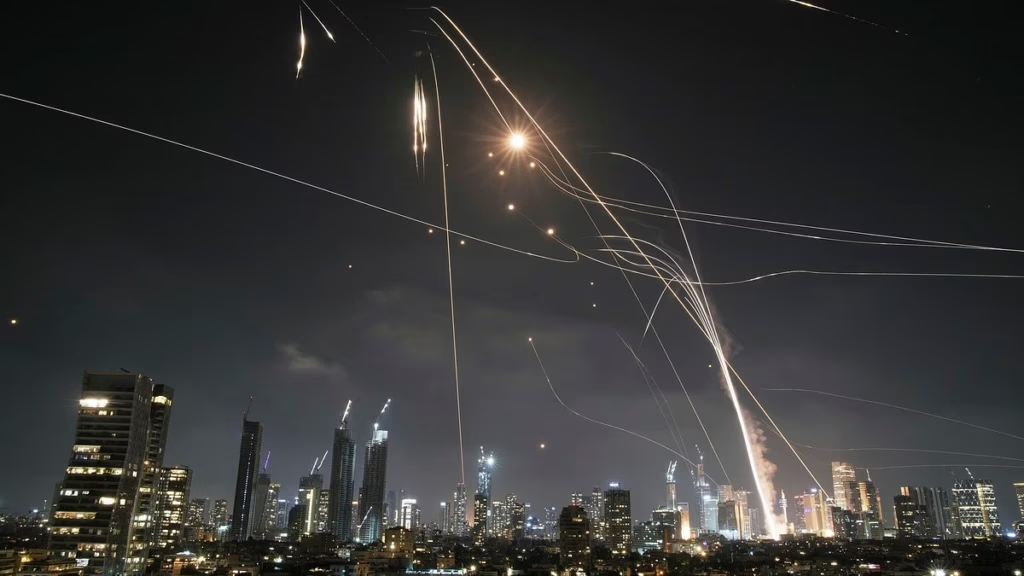
As the war enters its fourth week, what began as US-Israeli strikes on February 28 has metastasized into a full-blown regional conflagration . Iran is striking Gulf states with missiles and drones . Israel is bombarding Tehran and Beirut . The Houthis have renewed attacks on Red Sea shipping . Iraq has been pulled deeper into the fighting . And more than 3.2 million people have been displaced across the region .
The diplomatic landscape is equally shattered. America’s traditional allies — Germany, Britain, France, Spain, Poland, Japan, Australia — have refused President Donald Trump’s demands to help secure the Strait of Hormuz . NATO has declared this “not our war” . And Trump, in a blistering Truth Social post, has declared that the United States “DOES NOT NEED THE HELP OF ANYONE” .
Oil prices have surged past $100 per barrel . The Strait of Hormuz, through which 20 percent of global crude passes, is effectively closed . Global markets are in turmoil. And there is no end in sight.
This is the full investigation into the intensifying Middle East conflict — the military escalation, the diplomatic collapse, the economic fallout, and the terrifying question no one can answer: how does this end?
The War Expands: Iran Strikes Across the Gulf
UAE Under Fire: Drone Strikes Hit Oil Fields and Fujairah Terminal
The United Arab Emirates, long viewed as a relatively safe haven in a turbulent region, has become a primary target of Iranian retaliation. On Tuesday, a drone strike caused a fire at the Shah oil field, located 230 kilometers south of Abu Dhabi city, with a production capacity of approximately 70,000 barrels per day .
The Fujairah oil complex on the UAE’s east coast — a critical facility that enables the UAE to bypass the Strait of Hormuz for some exports — has been hit repeatedly. A drone strike on Tuesday caused a fire, though no injuries were reported . It was the third attack on the facility in four days .
ADNOC, the UAE’s state-owned energy giant, has “suspended” loading oil at the Fujairah terminal following the repeated strikes .
Qatar Intercepts Missiles as Explosions Rock Doha
Qatar, home to the massive Al Udeid air base that hosts US Central Command, has not been spared. Authorities said Tuesday they had intercepted a missile attack after an AFP journalist reported hearing several explosions in Doha .
Kuwait and Saudi Arabia Report Interceptions
Kuwait and Saudi Arabia have also reported intercepting Iranian missiles and drones . Two emergency health workers in Kuwait were injured when debris fell on an ambulance center .
First Fatality: Pakistani National Killed in Abu Dhabi
The human toll of these strikes is mounting. In Abu Dhabi, falling shrapnel from an intercepted missile killed a Pakistani national, city authorities confirmed . It is the first reported fatality from the Gulf state strikes.
Tehran Under Siege: Israel’s Decapitation Campaign Intensifies
Larijani Assassination Confirmed: Iran’s De Facto Leader Killed
On March 17, Israel delivered its most significant blow since the war began. An overnight airstrike on a hideout apartment in northern Tehran killed Ali Larijani, the 67-year-old secretary of Iran’s Supreme National Security Council and the man who had effectively run the Islamic Republic since the death of Supreme Leader Ayatollah Ali Khamenei .
Iran’s Supreme National Security Council confirmed his death, stating that Larijani’s son and his deputy, Alireza Bayat, were also killed in the strike .
Larijani was widely regarded as Iran’s most powerful figure after Khamenei, a pragmatist who could navigate between hard-liners and diplomats . His death eliminates the one leader capable of negotiating an end to the conflict.
New Supreme Leader Rejects Diplomacy: “Not the Time for Peace”
The assassination came as Iran’s new Supreme Leader, Mojtaba Khamenei — the son of the slain ayatollah — sent an unmistakable signal of defiance. According to an Iranian official speaking to AFP, Mojtaba has rejected proposals conveyed through diplomatic channels to “reduce tensions or agree a ceasefire with the United States” .
At his first foreign policy meeting since assuming office, Mojtaba reportedly told officials: “Now is not the time for peace” until the US and Israel “are forced to surrender, admit defeat and pay compensation” .
The message is clear: Iran will fight on.
Baghdad Drawn Deeper: US Embassy Attacked, Iranian Advisors Killed
The war has steadily pulled Iraq further into the fighting. On Tuesday, a drone and rocket attack targeted the US embassy in Baghdad’s heavily fortified Green Zone . A security official said “three drones and four rockets attacked the embassy, with at least one drone crashing inside it” .
Hours earlier, a missile strike on a house in Baghdad killed four people. Initial reports suggest two of the victims were “Iranian advisors” to Tehran-backed groups .
The attacks follow the killing of Abu Ali al-Askari, a senior security commander with Iraq’s Kataeb Hezbollah, though the circumstances of his death remain unclear .
Lebanon’s Humanitarian Catastrophe: One Million Displaced
Israeli Strikes Hit Beirut Residential Areas
Israel has expanded its campaign to Lebanon, where Hezbollah militants struck Israel on March 2 in response to Khamenei’s killing. On Tuesday, Israeli warplanes launched a “wide scale wave of strikes” on Hezbollah targets in Beirut .
Lebanese state media reported that strikes hit three neighborhoods in Beirut, including a residential apartment building in the southern suburbs, a Hezbollah stronghold . An Ethiopian woman was wounded in the strikes, according to the health ministry .
886 Dead, 130,000 in Shelters
The human toll in Lebanon is staggering. The health ministry reports that 886 people have been killed since March 2, including 67 women and 111 children . More than one million people have registered as displaced, with over 130,000 staying in more than 600 collective shelters .
Hezbollah’s War of Attrition
Hezbollah has responded with rocket attacks on northern Israel, drawing Israeli ground operations. Israel has announced “limited ground maneuvers” in southern Lebanon, defying international concerns about civilian consequences .
Israeli President Isaac Herzog told AFP that Europe should support “any effort to eradicate Hezbollah now” . But Western allies — Canada, France, Germany, Italy, and the United Kingdom — have urged restraint .
The Houthi Front: Red Sea Shipping Under Renewed Attack
CENTCOM Intercepts Drones and Missiles
Yemen’s Houthi rebels, who control much of the country, have resumed their campaign against Red Sea shipping. US Central Command said it intercepted four drones launched by the Houthis — three over the Red Sea and another over the Gulf of Aden — while a fifth drone crashed .
The Houthis also launched two anti-ship ballistic missiles, according to CENTCOM, which said no injuries or damage were reported .
16 Killed in US-UK Strikes on Hodeida
The US and Britain have responded with airstrikes on Houthi positions. On Friday, strikes on Hodeida killed 16 people and wounded dozens, according to Houthi military spokesperson Yahya Saree . An unspecified number of civilians were among the dead.
In response, the rebels launched a missile attack on the USS Dwight D. Eisenhower aircraft carrier in the Red Sea .
Tanker Chios Lion Struck by Maritime Drone
On March 12, the Houthis demonstrated their evolving capabilities. A coordinated attack on the Liberian-flagged oil tanker Chios Lion utilized a sea-based suicide drone and several unmanned aerial vehicles . The uncrewed surface vessel struck the port side of the tanker, causing a significant explosion .
The vessel remained seaworthy with minor damage, and no injuries were reported, but the attack marked a shift toward sophisticated, low-cost maritime drones that are difficult to intercept .
The Diplomatic Earthquake: Allies Abandon America
Trump’s Truth Social Broadside: “WE DO NOT NEED THE HELP OF ANYONE”
President Trump’s frustration with allied refusal boiled over on Tuesday in a characteristic Truth Social post.
“The United States has been informed by most of our NATO ‘Allies’ that they don’t want to get involved with our Military Operation against the Terrorist Regime of Iran,” Trump wrote, adding that it came “despite the fact that almost every Country strongly agreed with what we are doing” .
Trump said he was not “surprised,” stating he “always considered NATO, where we spend Hundreds of Billions of Dollars per year protecting these same Countries, to be a one way street — We will protect them, but they will do nothing for us, in particular, in a time of need” .
He concluded defiantly: “WE DO NOT NEED THE HELP OF ANYONE” .
NATO Allies Refuse: Germany, UK, France, Spain, Poland Say No
Behind Trump’s bravado lies a stark reality: America’s traditional allies have uniformly refused to help.
Germany has been the loudest “no.” Berlin “has been clear at all times that this war is not a matter for NATO” . British Prime Minister Keir Starmer said London is working with allies to craft a “viable” plan to reopen the strait, but ruled out a NATO mission .
France, Spain, Poland, Japan, Australia, Greece, and Sweden have also distanced themselves from any military involvement in the Strait of Hormuz . EU foreign ministers discussed the war in Brussels but showed “no appetite” for extending their Red Sea naval mission to help reopen Hormuz .
The One-Way Street: Trump’s Years of Alienation Come Due
The diplomatic isolation is not accidental. Trump has spent years demeaning European allies, demanding more defense spending, and questioning NATO’s value. Now that he needs their help, the accumulated resentment has come due.
As one European diplomat told reporters: “They didn’t consult us before starting this war. They said they didn’t need us. Now they do, and we’re supposed to come running? That’s not how alliances work.”
The Economic Fallout: Oil at $100 and Climbing
Strait of Hormuz Effectively Closed
The Strait of Hormuz, through which 20 percent of global crude oil passes, has been severely disrupted by the war . While Iranian Foreign Minister Abbas Araghchi has claimed the strait remains “operational for international shipping,” he added that vessels linked to the United States and Israel are “not permitted to pass” .
The practical effect is a blockade. Hundreds of ships, including many Indian vessels, remain stranded in the narrow sea lane between the Persian Gulf and the Gulf of Oman . A Pakistani oil tanker made the first non-Iranian transit since the war began, but it remains an exception .
Global Markets in Turmoil
Oil prices have surged more than 40 percent since the war began . On Tuesday, US benchmark West Texas Intermediate rose 5.16 percent to $98.32 a barrel, while Brent Crude also climbed above five percent .
Global markets have reacted with volatility. Stocks initially rose as oil prices pulled back slightly, but the underlying trend is clear: as long as the Strait of Hormuz remains closed, energy prices will remain elevated .
Strategic Reserves Released: IEA, Japan Tap Stockpiles
The International Energy Agency has activated its largest-ever coordinated response. IEA members agreed on March 11 to tap oil stockpiles to cushion the price surge .
Japan has begun releasing its strategic reserves, with IEA indicating releases would begin in Asia and Oceania before other regions . IEA chief Fatih Birol said more releases could follow: “In terms of government stocks and industry stocks held under government obligation, if you combine them, there will be still over 1.4 billion barrels remaining, which means we can do more later as and if needed” .
Australia’s central bank hiked its key interest rate Tuesday, pointing to “sharply higher fuel prices” driven by the war .
Iraq Reroutes Oil via Turkey, Jordan, Syria
Iraq, which previously exported approximately 3.4 million barrels per day through its southern ports and the Strait of Hormuz, has been forced to adapt . Oil Minister Hayyan Abdul Ghani announced that Iraq will begin pumping crude oil directly from the Kirkuk fields to Turkey’s Ceyhan port, bypassing the Kurdistan Region .
Current production is down to 1.5-1.6 million barrels per day . The ministry is exploring alternatives including using Jordanian and Syrian pipelines, though capacity constraints remain .
The US-Israel Divide: Different Goals, Different Timelines
Trump vs. Netanyahu: “Might Be a Little Different”
As the war grinds on, signs are emerging of a widening gap between Washington and Tel Aviv over what victory should look like .
Last week, Trump confirmed the differences, telling reporters his goals for ending the war “might be a little different” from those of Israeli Prime Minister Benjamin Netanyahu .
Regime Change vs. Limited Objectives
Analysts say the divergence is fundamental. “Israel has been clear in wanting the regime of the Islamic Republic to fall,” said Jack Clayton, a US foreign policy analyst . Netanyahu has long sought the collapse of Iran’s political system — a goal that would be difficult to achieve without deeper US involvement .
Washington’s objectives, by contrast, have evolved repeatedly. “There was regime change as a stated goal… then dismantling its nuclear program… to then saying that the purpose was to destroy the ballistic missile system,” Clayton noted .
Trump has drawn parallels to Venezuela, where an American operation ousted President Nicolas Maduro but left much of the government structure intact under his deputy . That suggests a more limited outcome than Netanyahu seeks.
Exit Strategy? “There Is No Clear Objective”
Clayton described Trump’s approach as an “anti-Powell Doctrine” — a reference to the US military principle that emphasizes clear goals and defined exit strategies before engaging in war.
“There is a lack of a clear objective, lack of an exit strategy, and a lack of domestic and international support,” he said .
Ahron Bregman, a UK-based Israeli political analyst, said differences are also emerging over timing. “The Israelis would prefer to extend the conflict for as long as possible, potentially for weeks, to weaken the Iranians,” he said. “I believe Trump will soon seek a way to end this war, especially as oil prices continue to rise” .
The Humanitarian Toll: 3.2 Million Displaced
Iran’s Internal Crisis: Internet Blackout, Protests Suppressed
Inside Iran, the war has compounded existing tensions. More than 1,200 Iranians have been killed by US and Israeli strikes, according to the last toll from Iran’s health ministry on March 8 . The country has endured more than two weeks of internet blackout .
Security forces, which killed thousands during protests in January, remain on high alert. But there is little sign of a popular uprising . Some Iranians have sought to restore a sense of normalcy, with cafes and restaurants reopening and the popular Tajrish bazaar in Tehran busy ahead of the Persian new year .
UN Refugee Agency Sounds Alarm
The UN refugee agency says up to 3.2 million people have been displaced across the region . Lebanon accounts for more than one million of that total, with hundreds of thousands more displaced in Iraq and Iran.
Nowruz Under Fire: A Holiday Without Peace
The Persian new year, Nowruz, falls on Friday. It is normally a time of celebration, family gatherings, and hope for renewal. This year, it arrives under the shadow of war.
Israeli Prime Minister Benjamin Netanyahu sent wishes to Iranians for the holiday, adding: “This year this holiday has special meaning… I take this opportunity to wish you a happy Nowruz — a year of freedom. A new beginning of hope to all of you” .
For the millions displaced, the families mourning lost children, and the nations caught in a conflict not of their making, that hope remains elusive.
Expert Analysis: How Does This End?
The Hard-Liner Ascendancy
The assassination of Ali Larijani, the rejection of diplomacy by new Supreme Leader Mojtaba Khamenei, and the consolidation of power by IRGC hard-liners all point in one direction: Iran will fight on .
Hamidreza Azizi of the German Institute for International and Security Affairs warned after Larijani’s death: “This process of elite-thinning, every layer that you remove, the next layer is going to be more hard-line” . With Larijani gone, the skills of consensus-building and pragmatic negotiation are gone too.
No Negotiating Partners
President Trump acknowledged the problem on Monday: “We don’t even know their leaders. We have people wanting to negotiate. We have no idea who they are” .
If the United States cannot identify negotiating partners, it cannot negotiate an end to the war. And if it keeps killing the officials who might have the clout to negotiate, it forecloses that option entirely.
The Impulse President
Analysts increasingly describe Trump’s decision-making as impulsive and unpredictable. “There is so often so little plan in the first place, so he acts impulsively as a result,” Clayton observed .
That unpredictability cuts both ways. Trump could escalate further, or he could suddenly declare victory and withdraw. No one knows — including, perhaps, Trump himself.
Conclusion: The War No One Can Stop
Three weeks into this conflict, the forces driving it forward are far stronger than the forces pushing for peace.
Iran’s new leadership is committed to fighting on, demanding surrender and compensation before any ceasefire . Israel sees a historic opportunity to cripple its arch-enemy and shows no sign of restraint . The United States is led by a president whose objectives shift by the day and whose allies have abandoned him .
The human cost mounts: 3.2 million displaced, more than 1,200 dead in Iran alone, 886 dead in Lebanon, untold suffering across the region .
The economic cost spreads: oil at $100, markets in turmoil, supply chains disrupted, inflation rising globally .
And still the missiles fly. Still the drones strike. Still the children die.
The Middle East conflict intensifies, with no end in sight.
Join Dusk on WhatsApp
Get the latest news, videos and blogs straight to your phone.
Join Now