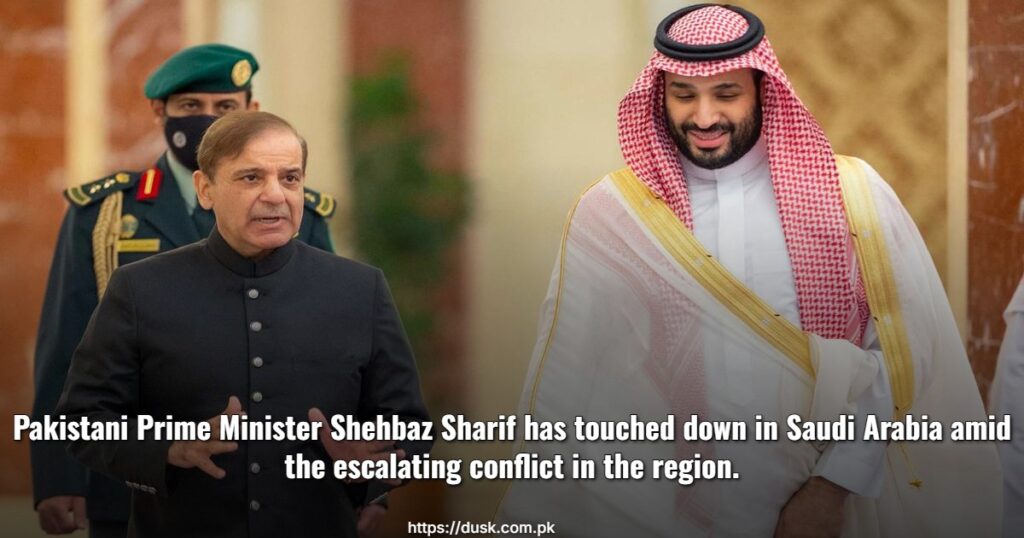
Defending the Kingdom: PM Shehbaz Arrives in Saudi Arabia as Defense Pact Faces Ultimate Test
JEDDAH, Saudi Arabia – March 13, 2026 – Pakistani Prime Minister Shehbaz Sharif touched down in Jeddah on Thursday for high-stakes talks with Saudi Crown Prince Mohammed bin Salman, as the kingdom activates its landmark defense agreement with Islamabad amid unprecedented Iranian missile and drone strikes on Gulf territory .
The visit, confirmed by Pakistan’s Foreign Office, marks the second high-level Pakistani delegation to Riyadh in less than a week, following emergency consultations between Chief of Defense Forces Field Marshal Asim Munir and Saudi Defense Minister Prince Khalid bin Salman on March 7 . Deputy Prime Minister and Foreign Minister Ishaq Dar accompanies the premier on this crucial mission
Defense Pact Put to the Test.
At the heart of the discussions lies the Strategic Mutual Defense Agreement (SMDA) signed by Pakistan and Saudi Arabia in September 2025. The pact’s core provision—treating any attack on one nation as aggression against both—was formalized during a period of regional tension following Israeli strikes on Qatar, but neither party anticipated its activation would come so soon, nor under such complex circumstances .
Saudi Arabia has faced at least 10 drone strikes and two cruise missile attacks since late February, with three ballistic missiles targeting Prince Sultan Air Base in early March. While most projectiles were intercepted, one missile struck the base, which hosts both Saudi and US personnel . The Shaybah oil field, crucial to Saudi production, has also been repeatedly targeted .
Prince Khalid bin Salman, following his meeting with Pakistan’s army chief, emphasized on social media that both nations discussed “measures needed to halt them within the framework of our Joint Strategic Defense Agreement,” stressing that such actions “undermine regional security and stability” .
Pakistan’s Diplomatic Tightrope
The Pakistani delegation arrives in Saudi Arabia after Prime Minister Sharif held a telephone conversation Wednesday with Iranian President Masoud Pezeshkian, who urged recognition of Tehran’s “legitimate rights” and firm international guarantees against “future aggression” as the only path to ending the conflict .
This diplomatic balancing act reflects Islamabad’s excruciating position. Pakistan shares a 900-kilometer border with Iran and maintains significant economic and security ties with Tehran, while simultaneously holding binding defense obligations to Riyadh .
“We have operated on the principle of being there for the other,” said Mosharraf Zaidi, the Prime Minister’s spokesperson for foreign media, emphasizing that Pakistan’s commitment to Saudi Arabia is unquestionable “no matter what and no matter when” .
Yet the spokesperson also highlighted Islamabad’s parallel efforts at conflict prevention: “The real question is what is Pakistan doing to make sure things don’t come to a point where any of its closest partners are further embroiled in a conflict” .
Domestic Complications
Pakistan’s calculations extend beyond diplomatic geometry. An estimated 15-20% of Pakistan’s 250 million citizens are Shia Muslims, and the reported death of Iran’s former Supreme Leader Ayatollah Ali Khamenei in US-Israeli strikes has already triggered violent domestic protests claiming at least 23 lives .
Analysts warn that overt Pakistani military participation alongside Saudi Arabia against Iran could inflame sectarian tensions, potentially reactivating groups like the Zainabiyun Brigade—a Pakistan-origin Shia militia trained and commanded by Iran’s Islamic Revolutionary Guard Corps .
The situation is further complicated by Pakistan’s concurrent border tensions with Afghanistan, which erupted in clashes just days before the current Middle East crisis began .
What Pakistan Can Offer
Regional experts suggest Pakistan’s most viable contribution may be defensive rather than offensive. “Pakistan can assist in enhancing Saudi air defense capabilities,” said analyst Aziz Alghashian, noting that such support is “militarily significant and politically defensible” as a purely protective measure .
Islamabad-based security analyst Amir Rana similarly observed that since “Iran’s main threat is drone and missile attacks, Pakistan can assist Saudi Arabia in this domain—though this would also mean Islamabad becomes entangled in the war, with enormous uncertainties” .
A retired senior Saudi diplomat, Dr. Ali Awadh Asseri, who served as ambassador to Pakistan from 2001 to 2009, has controversially claimed that “Pakistan would be prepared to deploy up to 100,000 troops if requested by Crown Prince Mohammed bin Salman,” adding that “if Saudi Arabia ever needs a nuclear or non-nuclear air force, Pakistan will not desert us” . However, analysts caution against reading nuclear dimensions into the agreement, noting Pakistan’s nuclear doctrine remains “India-centric” .
Energy Security Dimension
Beyond military coordination, Prime Minister Sharif’s visit addresses critical energy concerns. Iran’s closure of the Strait of Hormuz since approximately March 1 has sent global oil prices surging and directly threatens Pakistan’s energy security .
Saudi Arabia has arranged to support Pakistan’s oil and diesel supplies despite the crisis. A Pakistan National Shipping Corporation vessel has reached Yanbu port and is expected to depart for Karachi carrying approximately 73,000 tonnes of crude oil, with another vessel loading at Fujairah .
Pakistan relies heavily on Gulf energy imports and has approximately 1.5 to 2 million citizens working in Saudi Arabia and other Gulf states, whose remittances form a crucial pillar of the national economy .
The Path Forward
As Prime Minister Sharif meets with Crown Prince Mohammed bin Salman, the discussions will navigate between treaty obligations and conflict prevention. The Prime Minister’s Office stated that talks would cover “the ongoing tensions in the region, the regional security situation and bilateral relations” .
University of Lahore historian and analyst Dr. Ilhan Niaz summarized Pakistan’s strategic dilemma: “If Pakistan is forced to choose between Iran and Saudi Arabia, the answer will only be Saudi Arabia” . Yet others caution that geographical reality limits Islamabad’s options, with the volatile, Iran-adjacent Balochistan province presenting severe security vulnerabilities in any conflict scenario .
For now, Pakistan pursues what analyst Amil Khan terms “dual appeasement”—providing Saudi Arabia with intelligence and defensive support while maintaining diplomatic engagement with Tehran . Whether this balancing act can survive escalating regional confrontation remains the central question as Prime Minister Sharif begins his crucial talks in Jeddah.
Join Dusk on WhatsApp
Get the latest news, videos and blogs straight to your phone.
Join Now