Pakistan Mediating US-Iran War: Islamabad Hosts Talks to End Middle East Conflict | Exclusive
ISLAMABAD — In four weeks of devastating war that has killed more than 1,300 Iranians, displaced over 3 million people across the region, and sent oil prices surging past $100 per barrel, the world has searched desperately for an off-ramp. The United States and Israel have assassinated Iran’s de facto leader. Iran has struck Gulf states and effectively closed the Strait of Hormuz. NATO allies have refused to help Washington. And now, improbably, Pakistan has stepped forward .
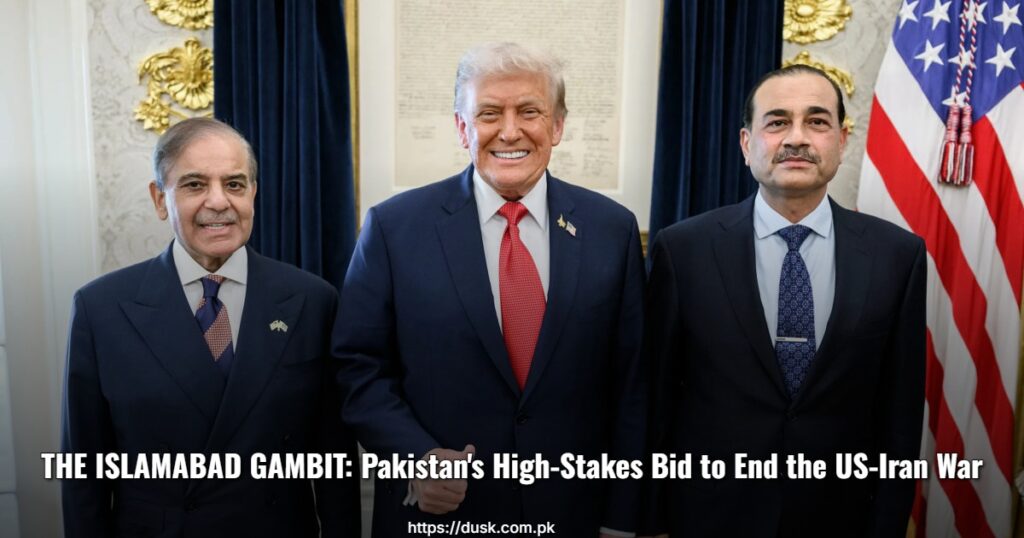
On Tuesday, Prime Minister Shehbaz Sharif made a formal offer: Islamabad stands “ready and honored” to host “meaningful and conclusive talks” between the United States and Iran for a “comprehensive settlement” of the conflict . The announcement followed a weekend of intense backchannel diplomacy involving Pakistan’s powerful army chief, Field Marshal Asim Munir, who reportedly spoke directly with President Donald Trump .
The offer comes at a moment of maximalist contradictions. President Trump announced a five-day pause on strikes against Iranian energy infrastructure, citing “very good and productive conversations” with Tehran . Yet Iran’s foreign ministry officially denies any direct negotiations, dismissing Trump’s claims as “psychological warfare” intended to manipulate oil prices . Simultaneously, Tehran acknowledges receiving messages through “friendly countries” — a diplomatic formulation that appears to confirm Pakistan’s role as intermediary .
I have covered South Asian diplomacy for two decades, from the Kargil conflict to the US withdrawal from Afghanistan. I have never seen Pakistan position itself as a mediator between global powers with this degree of urgency — or with this much at stake. This is the inside story of Islamabad’s diplomatic gambit: the players, the motivations, the obstacles, and the question no one can answer: can Pakistan actually pull this off?
The Offer: Islamabad’s Public Bid to Host ‘Conclusive Talks’
PM Shehbaz Sharif’s X Post: “Pakistan Stands Ready and Honored”
On March 24, 2026, Prime Minister Shehbaz Sharif took to X (formerly Twitter) with a statement that signaled Islamabad’s formal entry into the highest levels of Middle East diplomacy .
“Pakistan welcomes and fully supports ongoing efforts to pursue dialogue to end the WAR in Middle East, in the interest of peace and stability in region and beyond,” Sharif wrote .
Then came the offer: “Subject to concurrence by the US and Iran, Pakistan stands ready and honored to be the host to facilitate meaningful and conclusive talks for a comprehensive settlement of the ongoing conflict” .
The language was carefully chosen. “Meaningful and conclusive” signaled that Pakistan is not interested in symbolic diplomacy or preliminary exchanges — it aims to host the final, decisive negotiations that could end the war . The phrase “comprehensive settlement” suggested that Islamabad is prepared to facilitate discussions beyond a simple ceasefire, potentially addressing the underlying issues that triggered the February 28 escalation .
Trump’s Social Media Response: Acknowledgment Without Commitment
Hours after Sharif’s post, President Trump shared it on his Truth Social platform . But he made no indication of whether he would accept the Pakistani offer .
The silence was telling. Trump, who rarely misses an opportunity to announce diplomatic breakthroughs, has been unusually circumspect about the details of US-Iran engagement. On Monday, he told reporters that talks had begun on Sunday and continued into Monday, with Special Envoy Steve Witkoff and his son-in-law Jared Kushner involved . He described the conversations as “very good and productive” and announced a five-day pause on strikes against Iranian energy infrastructure .
But when asked about Pakistan’s role, Trump demurred. A White House spokesperson later cautioned that “no formal negotiations are underway and nothing is concrete as of yet,” adding: “These are sensitive diplomatic discussions and the United States will not negotiate through the news media” .
The Players: Who Is Talking to Whom?
Asim Munir’s Secret Call with Donald Trump
The most significant — and most closely guarded — development in Pakistan’s mediation effort involves its army chief. According to multiple sources, Field Marshal Asim Munir spoke directly with President Trump on Sunday, March 22 . The Financial Times first reported the conversation, citing people familiar with the matter .
But the backchannel may have begun even earlier. Pakistan’s former ambassador to Oman, Imran Ali Chaudhry, told 92 News that Munir traveled to Oman approximately two-and-a-half weeks ago on an undisclosed trip . There, he reportedly held a four-hour meeting with Steve Witkoff and Jared Kushner, Trump’s key envoys .
The Oman meeting, if confirmed, suggests that Pakistan’s mediation efforts predate Sharif’s public offer by weeks. It also indicates that the United States has been actively seeking alternative channels to engage Iran after traditional mediators — Oman, Qatar, Egypt — became less viable due to fraying relations or mistrust from either side .
Shehbaz Sharif’s Conversation with Masoud Pezeshkian
While Munir engaged Washington, Sharif focused on Tehran. On Monday, the prime minister spoke with Iranian President Masoud Pezeshkian .
During the call, Sharif “underscored the urgent need for collective efforts to settle differences through diplomacy,” particularly as the conflict threatens regional energy and water security . He assured Pezeshkian that “Pakistan would continue to play a constructive role in facilitating peace in the region” .
The readout of the call emphasized Pakistan’s solidarity with Iran — a crucial signal given Tehran’s wariness of any mediation effort that might be perceived as favoring Washington .
The US Envoys: Witkoff, Kushner, and the Oman Backchannel
The Trump administration’s envoys in this effort are familiar faces. Steve Witkoff, a real estate developer and Trump golfing partner, has been playing a key role in the current talks . His son Zachary has his own ties to Pakistan: he visited Islamabad twice in the past year to negotiate cryptocurrency deals and was pictured with Munir and Sharif at a signing ceremony in January .
Jared Kushner, Trump’s son-in-law and former White House adviser, brings Middle East experience from his role in the Abraham Accords. His involvement signals that the administration is seeking to replicate the deal-making approach that characterized his first-term diplomacy .
The Financial Times reported that other US officials could travel to Islamabad if an agreement appeared likely, possibly including Vice President JD Vance .
Iran’s Dual Track: Public Denial, Private Engagement
Perhaps the most fascinating aspect of this diplomatic dance is Iran’s public-private split.
Officially, Tehran denies any negotiations are taking place. Foreign Ministry spokesperson Esmaeil Baghaei told reporters: “Over the past few days, messages were received via certain friendly states conveying the US request for negotiations to end the war. Appropriate responses were given in accordance with the country’s fundamental positions” .
Parliament Speaker Mohammad Bagher Ghalibaf went further, dismissing Trump’s claims as “fake news” and “psychological warfare” intended to manipulate oil prices .
Yet the admission that “messages were received from friendly countries” is itself confirmation that something is happening . The Iranian formulation — acknowledging contact through intermediaries while denying direct engagement — is a classic diplomatic hedge. It allows Tehran to explore the possibility of negotiations without appearing weak or desperate .
Why Pakistan? The Strategic Logic of an Unlikely Mediator
Unique Geopolitical Positioning: Friends to Both Sides
Pakistan’s emergence as a potential mediator is not accidental. It is one of the few countries in the world with warm ties to both Washington and Tehran .
“Pakistan mediating and hosting talks wouldn’t be that surprising,” Michael Kugelman, a senior fellow at the Atlantic Council, told The Japan Times. “It’s one of the few countries with warm ties with both Washington and Tehran, and it has engaged closely and continuously with senior officials in both capitals over the last year” .
This dual-access is rare. Most US allies in the region — Saudi Arabia, the UAE, Qatar — have strained relations with Iran. Conversely, Iran’s allies — Russia, China, Syria — have limited influence in Washington. Pakistan, by contrast, maintains functional relationships with both adversaries .
The Saudi Defense Pact: A Complicating Factor
However, Pakistan’s relationship with Saudi Arabia complicates its mediation role. In September 2025, Islamabad and Riyadh signed a defense pact that states “any aggression against either country would be considered aggression against both” — a clause reminiscent of NATO’s Article 5 .
The pact creates a potential conflict of interest. Saudi Arabia has been targeted by Iranian missiles and drones during the war . If Riyadh were to invoke the defense pact, Pakistan would face an impossible choice: side with its longtime patron against its neighbor, or break its treaty commitment.
Pakistan’s diplomats have been working to ensure that Riyadh does not demand such a choice. According to a person familiar with the matter, Pakistan tried hard to ensure that a recent joint statement by Arab and Muslim countries “didn’t contribute to an escalation in the rhetoric between Iran and its Gulf neighbors” .
Energy Security: Pakistan’s Existential Stake in Gulf Stability
For Pakistan, this is not abstract diplomacy — it is survival. The country imports almost all of its crude oil, refined petroleum products, and liquefied natural gas from Gulf nations .
The Strait of Hormuz, which carries approximately 20 percent of the world’s oil and liquefied natural gas, has been effectively shut since the fighting began . The disruption has triggered major gas shortages across South Asia, with Pakistan facing rolling blackouts and industrial closures .
Sharif’s conversation with Pezeshkian emphasized this point directly, highlighting the threat to regional energy and water security . For Islamabad, ending the war is not just a diplomatic achievement — it is an economic necessity.
The Shia Factor: Pakistan’s Second-Largest Shia Population
Pakistan’s domestic politics also shape its mediation calculus. The country is home to the world’s second-largest Shia population after Iran, comprising approximately 10-15 percent of its 240 million citizens .
When Ayatollah Ali Khamenei was killed in the February 28 strikes that began the war, deadly riots erupted at US diplomatic missions across Pakistan . The anger was genuine and widespread. By positioning itself as a mediator, Islamabad can channel that domestic sentiment toward a constructive outcome — or at least demonstrate that it is working to end the killing of Shia co-religionists.
The Broader Diplomatic Landscape: Not Acting Alone
Turkey’s Parallel Mediation Efforts
Pakistan is not the only country trying to end this war. Turkey, which had been involved in mediation before the conflict began, has remained active throughout .
Turkish officials have held talks with both Iranian representatives and Trump’s envoy Steve Witkoff, seeking to secure a temporary ceasefire . Pakistan’s Foreign Minister Ishaq Dar spoke with his Turkish counterpart Hakan Fidan on Monday, coordinating diplomatic efforts .
Egypt, Saudi Arabia, and the OIC Coordination
Egypt has also stepped into the mediation arena. Foreign Minister Badr Abdelatty held separate conversations with his Iranian and Pakistani counterparts over the weekend .
Last week, foreign ministers from Egypt, Turkey, Pakistan, and Saudi Arabia met in Riyadh to coordinate their approach . The meeting produced a joint statement that, while carefully worded, signaled collective concern about regional escalation.
Oman’s Historical Role as Mediator
Oman has served as a traditional mediator between Washington and Tehran for decades. The sultanate hosted secret talks that led to the 2015 nuclear deal and has continued to facilitate backchannel communications .
The report that Munir met with Witkoff and Kushner in Oman suggests that Islamabad is building on Omani mediation, not replacing it . According to sources familiar with the matter, the United States considered multiple locations for potential talks — Muscat in Oman, Doha in Qatar, Cairo in Egypt — but “fraying relations due to the war or mistrust from either Washington or Tehran toward those governments made those options less viable” . Pakistan emerged as the least objectionable option for both sides.
The Contradictions: Denials, Delay, and Disinformation
Iran’s Official Position: “No Direct Negotiations”
The public messaging from Tehran has been consistently dismissive. Foreign Ministry spokesperson Esmaeil Baghaei was unequivocal: “Iran has not engaged in any direct or indirect talks with the U.S. since the outbreak of the war” .
This is a stronger denial than the “no direct talks” formulation that typically leaves room for backchannel engagement. By claiming there have been no indirect talks either, Baghaei appeared to close the door entirely.
Tehran’s Admission: “Messages Received from Friendly Countries”
Yet even Baghaei’s denial contained a crucial caveat. He acknowledged that “over the past few days, messages were received via certain friendly states conveying the US request for negotiations to end the war” .
The distinction is semantic but significant. Iran denies “negotiations” — which would imply two-way engagement — while admitting receipt of “messages” — which could be one-way communications that Tehran has not answered substantively .
Trump’s “Productive Conversations” vs. Tehran’s “Fake News”
President Trump’s characterization of events could not be more different. He told reporters the US and Iran had held “very good and productive” conversations about a “complete and total resolution of hostilities in the Middle East” .
Tehran has dismissed this as “psychological warfare” intended to manipulate oil prices . Parliament Speaker Ghalibaf accused the United States of spreading “misleading information to influence global markets and shift attention from the conflict” .
The gap between these narratives is not merely rhetorical. It reflects a fundamental disagreement about whether diplomacy is actually underway — and if so, what form it takes.
The Stakes: What’s on the Table?
The Five-Day Pause on Strikes
The most concrete development in recent days is Trump’s announcement of a five-day halt on strikes targeting Iranian power plants and energy infrastructure .
The pause, announced Monday, is significant for several reasons. It suggests the administration believes diplomacy is making enough progress to warrant a temporary halt in military pressure. It also signals that the White House sees energy infrastructure as a key point of leverage — and is willing to withhold strikes to preserve that leverage.
But the pause is temporary. Trump warned that military action could resume if progress is not achieved within the window . The five-day timeline adds urgency to Pakistan’s mediation efforts.
The Strait of Hormuz: 20% of Global Oil at Stake
For Iran, the Strait of Hormuz is its most powerful bargaining chip. Since the war began, Iran has effectively closed the waterway, through which approximately 20 percent of the world’s oil and liquefied natural gas passes .
The closure has created what the Gulf Times called “the worst energy supply shock in history” . Oil prices have surged more than 40 percent since the war began, hitting global economies already struggling with inflation .
Iran’s position on the Strait appears non-negotiable in public. Foreign Ministry spokesperson Baghaei said Iran’s “position regarding key issues, including the Strait of Hormuz and conditions for ending the war, remains unchanged” . But in diplomatic negotiations, such declarations often precede concessions.
Iran’s Red Lines: Energy Infrastructure and the Strait
For Tehran, the protection of its energy infrastructure is existential. The strikes that Trump paused were targeting the country’s power plants and oil facilities — the economic backbone of the Islamic Republic.
Iran’s warnings have been explicit. Baghaei stressed that “any attack on critical infrastructure, particularly energy facilities, would trigger a swift and forceful military response” . But the fact that Iran is receiving messages through intermediaries suggests it may be willing to discuss conditions under which such attacks could be permanently halted.
Expert Analysis: Can Pakistan Pull This Off?
The Trust Deficit: “Humongous Gap” Between Washington and Tehran
James Dorsey, a senior fellow at Singapore’s S. Rajaratnam School of International Studies, is cautious about the prospects for success.
“If the two sides meet, and presumably that’s going to be indirect talks, not direct talks at this point, that’s a positive development,” Dorsey told The Japan Times. “But first of all, you’ve seen two rounds of negotiations in the last year that ended up in war. The Iranians are very distrustful. The gap of distrust is humongous between the United States and Iran. And that complicates discussions” .
The “two rounds of negotiations” Dorsey references occurred in the months before the war. Oman mediated talks that, according to the sultanate, had made significant progress on Iran’s nuclear program . Then, on February 28, the US and Israel launched strikes that killed Supreme Leader Ayatollah Ali Khamenei.
That history of “talking while bombing” has left deep scars. Iran’s leadership is unlikely to trust any US overture without concrete, verifiable steps toward de-escalation.
Past Failures: Two Rounds of Negotiations Ended in War
The February 28 strikes represent a catastrophic failure of diplomacy. Just two days before the war began, US and Iranian officials had concluded a round of talks in Geneva . Omani mediators believed significant progress had been made.
The lesson for Tehran is brutal: negotiations with the Trump administration may be a trap. This perception will shape every interaction in the current mediation effort.
The Hard-Liner Factor: Mojtaba Khamenei’s Rejection of Diplomacy
Iran’s new Supreme Leader, Mojtaba Khamenei — the son of the slain ayatollah — has signaled that he is not interested in compromise. According to an Iranian official speaking to AFP, Mojtaba has rejected proposals conveyed through diplomatic channels to “reduce tensions or agree a ceasefire with the United States” .
At his first foreign policy meeting since assuming office, Mojtaba reportedly told officials: “Now is not the time for peace” until the US and Israel “are forced to surrender, admit defeat and pay compensation” .
If this is Iran’s genuine position, no amount of Pakistani mediation can produce a breakthrough. But such hard-line statements are sometimes intended for domestic consumption — or as opening negotiating positions. The fact that Iran is engaging at all suggests the door remains slightly ajar.
Trump’s Impulsivity: “No Clear Exit Strategy”
Analysts also worry about the American side of the equation. Sanam Vakil from Chatham House told the Financial Times that Trump may lack the patience or strategic clarity to see negotiations through.
“It’s positive to play out what a compromise and agreement might look like, but I don’t see a willingness on either side to compromise,” Vakil said. “I don’t think Trump can walk away from this crisis of his making. And I just don’t see Iran caving. They feel they have the upper hand and the leverage, this is again about their survival and the conditions that will assure their survival” .
Jack Clayton, a US foreign policy analyst, described Trump’s approach as an “anti-Powell Doctrine” — a reference to the US military principle that emphasizes clear goals and defined exit strategies before engaging in war. “There is a lack of a clear objective, lack of an exit strategy, and a lack of domestic and international support,” Clayton said .
The Risks: What Could Go Wrong?
Pakistan’s Balancing Act: Iran, Saudi Arabia, and the US
Pakistan’s position is precarious. It must simultaneously maintain:
- Warm ties with Iran — its neighbor and the country it is mediating for
- Trust with Washington — the superpower it needs to keep engaged
- The defense pact with Saudi Arabia — its longtime patron and financial lifeline
Any misstep could break this three-way balance. If Pakistan appears to favor Washington, Tehran will walk away. If it appears too close to Tehran, Washington will lose faith. And if Riyadh demands Pakistan activate the defense pact, Islamabad will face an impossible choice .
The Domestic Factor: Protests, Riots, and Sectarian Tensions
Inside Pakistan, the war has already sparked deadly violence. After Khamenei’s killing, protesters attacked US diplomatic missions across the country, resulting in multiple deaths .
The Shia community, while a minority, is large enough to destabilize the country if it perceives the government as insufficiently supportive of Iran. At the same time, Sunni hardliners — and Pakistan’s powerful military establishment — are wary of appearing too close to Tehran.
Sharif’s government is walking a tightrope. Any negotiated outcome that is seen as favoring one side over the other could trigger domestic unrest.
The Afghanistan Distraction: Pakistan’s Eastern Front
Pakistan is also dealing with intensified cross-border attacks from Afghanistan . The fighting with Tehrik-i-Taliban Pakistan (TTP) has escalated in recent weeks, stretching Pakistani security forces.
While there is currently a pause in cross-border attacks, the situation remains volatile . If the eastern front flares up while Pakistan is trying to mediate in the west, its capacity to focus on diplomacy will be severely limited.
Conclusion: A Window of Opportunity or a Mirage?
Pakistan’s emergence as a mediator between the United States and Iran is, at minimum, a remarkable diplomatic development. A country often described as geopolitically unstable, economically fragile, and internally divided has positioned itself as the most credible venue for ending the Middle East’s most dangerous war in decades.
The pieces are in place for a diplomatic breakthrough. Pakistan has the trust of both sides. Trump has paused strikes. Iran is receiving messages through intermediaries. The world is desperate for an off-ramp.
But the obstacles are immense. The trust deficit between Washington and Tehran is measured not in years but in decades — and in blood. Iran’s new supreme leader has publicly rejected diplomacy. Trump’s impulsivity and lack of clear strategy could derail any progress. Pakistan’s own balancing act among Iran, Saudi Arabia, and the US is precarious.
A Pakistani government source told Gulf Times that discussions on a meeting were at an advanced stage and that if it did happen — “a big ‘if'” — it would take place within a week .
That “if” is the biggest word in diplomacy.
If the meeting happens, if the talks are productive, if both sides can overcome their profound distrust, and if Pakistan can hold the space for agreement — then Islamabad may achieve what no other capital has managed: an end to a war that has killed thousands, displaced millions, and threatened the global economy.
If not, the conflict will grind on, the missiles will keep flying, and the world will continue searching for a mediator that both sides can trust.
The next week will tell us which path we are on.
Join Dusk on WhatsApp
Get the latest news, videos and blogs straight to your phone.
Join Now