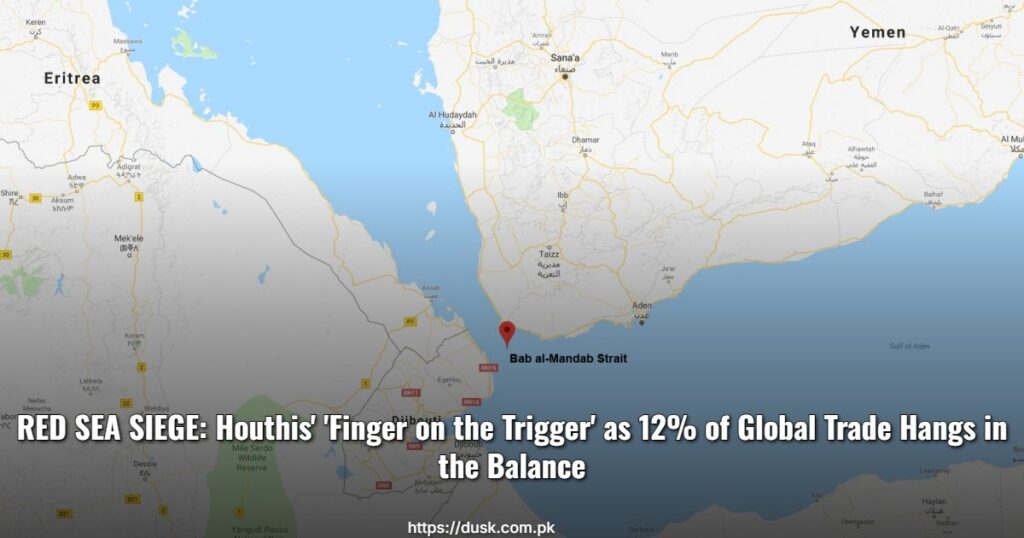
MINAB, IRAN — The world’s attention remains fixed on the Strait of Hormuz, where Iran has restricted tanker movements and traded threats with Washington. But 1,200 nautical miles to the southwest, another maritime chokepoint trembles on the edge of crisis .
Yemen’s Houthi rebels — Tehran’s most unpredictable proxy — have placed their “fingers on the trigger,” warning they could close the Bab el-Mandeb Strait and ignite a shipping catastrophe that would dwarf the Red Sea crises of 2023-2024 .
The Threat: What Houthi Leaders Are Saying
“Our Fingers Are on the Trigger” — Direct Quotes from Houthi Command
On March 5, 2026, Houthi leader Abdul Malik Al-Houthi addressed his followers in a televised speech that sent tremors through global shipping markets .
“Regarding military escalation and action, our fingers are on the trigger at any moment should developments warrant it,” he declared .
The message was unmistakable: the Houthis are poised to enter the widening conflict between Iran and the US-Israel alliance .
Days later, a Houthi military official, Abed al-Thawr, provided chilling specificity to Iranian media . He outlined exactly what a Houthi intervention would entail:
- Official declaration of a naval blockade against the United States and Israel
- Stopping merchant vessels and warships — including aircraft carriers — destined for US soil or Israeli ports
- Complete closure of the Bab el-Mandeb Strait to any ships bound for Israeli ports
“Once the decision to intervene is made, the first measure could be the official declaration of a naval blockade against the United States and the Zionist regime,” al-Thawr told Press TV .
The Axis of Resistance: Coordinating with Iran
Iran’s semi-official Fars News Agency has reported that the Houthis and other members of the so-called “axis of resistance” are on full alert and prepared to support Tehran in its expanding confrontation with the United States .
This coordination is critical. The Houthis have historically acted independently, but the current crisis — triggered by US-Israeli strikes that killed Iran’s Supreme Leader Ayatollah Ali Khamenei on February 28 — has unified Tehran’s proxies in ways not seen since the 2023 Gaza war .
Hezbollah in Lebanon and Iraqi militias have already entered the fray. The Houthis remain the last major proxy not to have fired a shot .
The Strategic Waterway: Why Bab el-Mandeb Matters
A Maritime Chokepoint of Global Significance
The Bab el-Mandeb Strait — whose name derives from the Arabic “Gate of Tears” — is a narrow 20-mile wide passage connecting the Red Sea to the Gulf of Aden . It is the southern gateway to the Suez Canal, the shortest maritime route between Europe and Asia .
Ships traveling from the Indian Ocean, carrying goods from China, India, and Southeast Asia, must pass through Bab el-Mandeb to reach the Suez Canal and the Mediterranean. There is no practical alternative .
By the Numbers: 12% of Global Trade at Risk
The statistics are staggering:
Energy Security: 8.8 Million Barrels Daily
Energy analysts emphasize that Bab el-Mandeb is not just a trade route — it is an energy artery . Nearly 9 million barrels of oil traverse these waters daily, destined for European and North American refineries .
During the 2023-2024 Red Sea crisis, when Houthis attacked more than 100 vessels, oil prices surged and shipping costs spiraled . A full closure would dwarf that disruption
The Domino Effect: From Red Sea to Global Economy
Suez Canal Revenues Plunge 40%
The Suez Canal is Egypt’s economic lifeline, generating billions in hard currency annually . But the canal is entirely dependent on vessels safely transiting Bab el-Mandeb. If the southern strait closes, the canal starves .
In January 2024 — during the height of Houthi attacks — Suez Canal revenues declined by 40 percent compared to the previous year, according to SCA Chairman Rabie . The number of ships passing through dropped 30 percent .
By November 2024, the cumulative toll was devastating: 3,562 vessels had been diverted away from the canal since attacks began in November 2023 .
Shipping Giants Reroute Around Africa
Seven of the world’s largest shipping companies — including CMA-CGM, Hapag-Lloyd, and Maersk — suspended Red Sea transits during the 2023-2024 crisis . They diverted vessels around Africa’s Cape of Good Hope, adding thousands of miles and weeks to journeys .
Now, with tensions rising again, Maersk has already suspended some services through Bab el-Mandeb .
The Cape of Good Hope Nightmare
The Cape route is a logistics nightmare :
- Journey time increases from 20-25 days to 30-40 days
- Fuel consumption spikes
- Crew wages multiply
- Small ships face winter safety risks
SCA Chairman Rabie emphasized that the Cape route “is also not safe for small ships in winter” . But for shipping companies facing Houthi missiles, winter waves may seem preferable to explosive drones.
Historical Context: The Houthi Maritime Campaign
2023-2025: The Gaza War Attacks
The Houthis are not new to maritime warfare. Following Hamas’s October 7, 2023 attack on Israel and the subsequent Gaza campaign, the rebels launched an unprecedented assault on international shipping .
Key facts from that campaign:
- More than 100 attacks on commercial vessels
- Weapons used: Drones, anti-ship missiles, fast boats
- Targets: “Any ships bound for Israeli ports” — later expanded to include US and UK vessels
- US and UK response: Airstrikes on Houthi positions in Yemen
The Houthis claimed solidarity with Palestinians, demanding Israel allow humanitarian supplies into Gaza .
October 2025 Ceasefire: A Temporary Calm
Following a US-brokered ceasefire between Israel and Hamas in October 2025, the Houthis ceased their attacks . For nearly five months, the Red Sea enjoyed relative peace .
UN Security Council records confirm that “no incidents have been recorded in the Red Sea since September 2025” . Russia’s UN representative argued this proves the attacks were “closely linked to the conflict in Gaza” .
The Galaxy Leader: Still Held After Two Years
One dark legacy remains: the Galaxy Leader .
On November 19, 2023, Houthi commandos seized the Japanese-operated vehicle carrier, linked to an Israeli businessman, along with its 25 crew members . The UN Security Council has repeatedly demanded their release .
As of March 2026 — nearly two and a half years later — the crew remains in Houthi captivity .
The Strategic Question: Why Haven’t the Houthis Fired Yet?
This is the question confounding analysts: with Iran under attack and proxies across the region joining the fight, why do the Houthis hold back?
Domestic Priorities vs. Regional Loyalties
Unlike Hezbollah, which explicitly follows Iran’s Supreme Leader, the Houthis are motivated primarily by a domestic agenda . They control Sana’a and large swaths of Yemen, but they govern a population suffering one of the world’s worst humanitarian crises .
The Zaydi Doctrine: Not Bound to Tehran
The Houthis adhere to the Zaydi sect of Shi’ite Islam, which differs doctrinally from the Twelver Shi’ism of Iran’s leadership . While Iran champions them as part of the “Axis of Resistance,” Houthi religious doctrine does not require allegiance to Tehran’s Supreme Leader .
Fear of Retaliation: Saudi, US, Israeli Response
Perhaps most pragmatically, the Houthis fear the response .
If they join the war, they would face:
- Intense US airstrikes — far heavier than 2023-2024
- Israeli strikes on Houthi positions
- Possible Saudi intervention — Riyadh has temporarily halted oil shipments through Bab el-Mandeb after Houthi attacks on Saudi tankers
Given growing economic pressure at home, some analysts believe the Houthis may sit out the conflict altogether .
But others warn they are “keeping their powder dry for an opportune moment” to exert maximum pressure .
What a Closure Would Mean
30-40 Day Journeys Replace 20-Day Routes
If Bab el-Mandeb closes, the math is brutal :
| Route | Typical Transit Time |
|---|---|
| Asia-Europe via Suez | 20-25 days |
| Asia-Europe via Cape of Good Hope | 30-40 days |
That’s two additional weeks of fuel, wages, and delayed goods .
Oil Prices Surge 40% — And Could Go Higher
In the last two weeks alone, oil prices have increased by more than 40 percent . If Bab el-Mandeb closes, energy experts warn of further spikes .
Every 1 million barrels of oil removed from daily supply sends shockwaves through global markets. Bab el-Mandeb carries nearly 9 million barrels daily .
Supply Chain Chaos: Lessons from 2023-2024
The 2023-2024 Red Sea crisis offered a preview :
- Shipping costs skyrocketed
- Insurance premiums for Red Sea transits multiplied
- Delivery delays rippled through global supply chains
- Inflationary pressures mounted
A full closure would make that crisis look mild.
International Response: UN, Security Council, and Sanctions
UN Resolution 2812 Extends Monitoring
On January 14, 2026, the UN Security Council adopted Resolution 2812, extending monthly reporting on Houthi attacks in the Red Sea until July 15, 2026 .
The vote was 13-0, with China and Russia abstaining .
US Ambassador Linda Thomas-Greenfield welcomed the resolution, stating: “It reaffirms the Council’s responsibility for continued vigilance against the Houthi terrorist threat to the freedom of navigation in the Red Sea” .
Russia and China Abstain, Question Focus
But Moscow and Beijing struck a different tone .
Russia’s UN representative argued the resolution has “no added value,” noting that “no incidents have been recorded in the Red Sea since September 2025” . She suggested the Council would “do better to monitor shipping vessels in the Caribbean, not in the Red Sea” .
China echoed this, expressing regret that “one State took military action against Yemen and thereby escalated tensions in the Red Sea” — an apparent reference to US-UK strikes .
US and UK Naval Presence
Despite the diplomatic disagreements, US and UK naval forces remain in the region. In January 2024, they shot down 21 drones and missiles fired by Houthi rebels in a single engagement .
The USS Dwight D. Eisenhower carrier strike group has patrolled Red Sea waters, and US officials have warned of “serious consequences” should Houthi attacks resume .
Regional Fallout: Saudi Arabia Suspends Oil Shipments
Tanker Attacks Force Saudi Halt
The Houthis have already demonstrated their willingness to target Saudi vessels .
In a recent incident, two Saudi oil tankers — each carrying 2 million barrels — were attacked by Houthi rebels in the Red Sea .
Saudi Energy Minister Khalid al-Falih announced an immediate suspension: “All oil shipments through Bab al-Mandab Strait have been suspended temporarily until… maritime transit through the area is safe” .
State oil giant Aramco confirmed “one of the ships sustained minimal damage. No injuries nor oil spill have been reported” .
Bahrain Condemns “Flagrant Violation”
Bahrain strongly condemned the attack, calling it “a flagrant violation of international laws and norms” that “poses a serious threat to the freedom of international trade and maritime navigation in Bab Al-Mandab Strait and the Red Sea” .
Conclusion: The World Holds Its Breath
The Coming Days Will Determine Global Trade’s Fate.
Join Dusk on WhatsApp
Get the latest news, videos and blogs straight to your phone.
Join Now