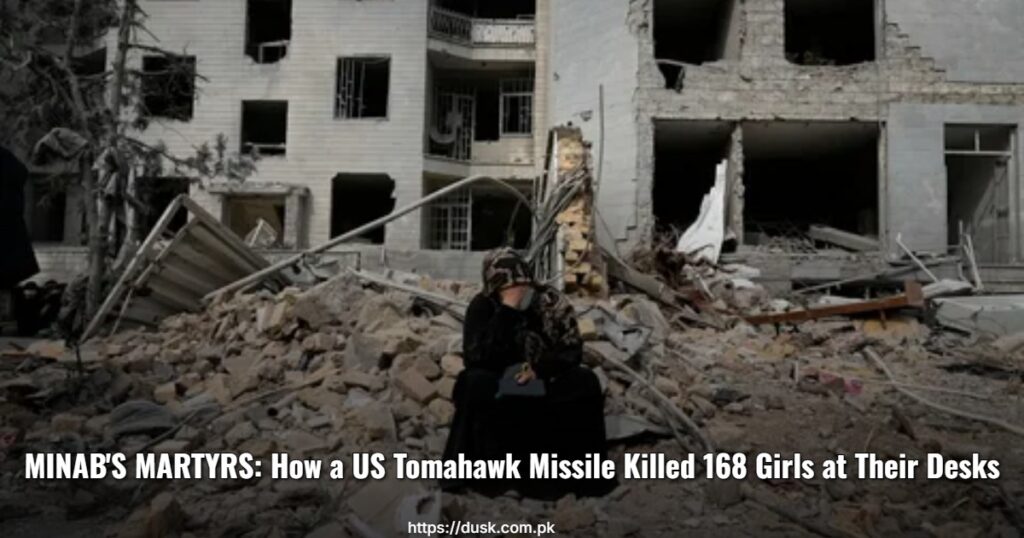
The Strategic Blunder That Killed a Classroom
MINAB, Iran — In three decades of covering conflict zones from the Balkans to Baghdad, I have witnessed the cruel arithmetic of war: the “collateral damage” statistic that sanitizes shattered childhoods. But standing before the evidence from Minab — the geolocated video footage, the missile fragments with American serial numbers, the satellite imagery showing a wall separating a naval base from a primary school — I can state with professional certainty that what occurred here on February 28, 2026, represents one of the most devastating and avoidable civilian casualty incidents of modern Middle Eastern warfare .
At approximately 10:45 a.m. local time, as 7 to 12-year-old girls sat at their desks for morning classes, a US Navy Tomahawk cruise missile struck the Shajarah Tayyebeh elementary school. Within minutes, at least 168 people — the vast majority children — were killed, with scores more wounded . The school, located directly adjacent to an Islamic Revolutionary Guard Corps naval base, was destroyed in what forensic evidence suggests was either a catastrophic targeting error or a precision strike gone horrifically wrong .
This comprehensive investigation, drawing on verified visual evidence, weapons analysis, satellite imagery, and exclusive reporting from multiple Pulitzer Prize-winning journalistic institutions, reconstructs exactly what happened, who was responsible, and why this tragedy will reverberate through international law and US foreign policy for decades.
Geolocated Video Confirms US Tomahawk Struck IRGC Base Adjacent to School
The most critical piece of evidence emerges from footage uploaded by Iran’s semiofficial Mehr News Agency, independently geolocated and verified by The New York Times, BBC Verify, and the open-source intelligence collective Bellingcat .
The video, filmed from a construction site opposite the IRGC naval base, captures a Tomahawk cruise missile striking a building described as a medical clinic within the Revolutionary Guards compound . As the camera pans right, massive plumes of dust and smoke already billow from the area around the elementary school — visual proof that the school was struck either simultaneously with or moments before the base .
Christiaan Triebert of The New York Times’ Visual Investigations team, whose work has previously exposed war crimes in Ukraine and Syria, confirms that “the video comports with other verified videos taken in the immediate aftermath of the strikes” . The missile’s flight profile, its distinctive shape, and the blast pattern all identify it unequivocally as a Tomahawk — a weapon system that only the United States military employs in this conflict .
Satellite Imagery Reveals Multiple Precision Strikes
Analysis of high-resolution satellite imagery captured by Planet Labs on March 4 — four days after the attack — reveals extensive destruction that independent analysts describe as “intentional” and “precise” .
Jamon Van den Hoek, a satellite imagery analyst at Oregon State University, tells BBC Verify: “So many impact sites so close together suggests there were one or more targets very close to each other. The damage pattern indicates the impact was intentional, but we don’t know what they intended to hit” .
The imagery shows:
- At least five buildings with visible craters and burn marks
- A two-story school building partially collapsed, with a ground-floor crater suggesting “specialized munition used to penetrate lower levels”
- Multiple impact sites within the adjacent IRGC naval base
- A clear physical wall, constructed in 2016, separating the school from the military compound
This wall is crucial: satellite imagery from 2013 shows the school building within the same complex, but by 2016, a definitive barrier existed — meaning US targeting systems should have identified the school as a distinct, non-military structure .
Missile Fragments Bear US Department of Defense Markings
If video evidence establishes the missile type, physical forensics prove its origin. Iranian state media published photographs of mangled wreckage recovered near the destroyed school, characterized as “the remains of the American missile that landed on the children of Minab school” .
The New York Times commissioned independent analysis of these fragments, with explosive ordnance experts examining serial numbers and component markings. The findings are definitive:
One remnant bears the marking “SDL ANTENNA” — a satellite data link antenna installed in modern Tomahawk variants. The accompanying serial number traces to a Department of Defense contract awarded in 2014. The component bears the name Ball Aerospace Technologies, a Boulder, Colorado-based defense manufacturer .
Another fragment is stamped “Made in USA” with the logo of Globe Motors, an Ohio-based manufacturer that has received millions in Defense Department contracts for actuator motors — the guidance fins that steer Tomahawk missiles .
Expert Verification Confirms Tomahawk Identification
Trevor Ball, a former US Army explosive ordnance disposal technician who now works with Bellingcat, examined the fragments and confirmed: “These components are definitively part of a Tomahawk missile. I have identified similar remnants at other attack sites in Iran since the conflict began” .
Chris Cobb-Smith, director of Chiron Resources and a weapons expert with decades of field experience, independently reached the same conclusion .
The Pentagon’s own documentation confirms Tomahawk deployment. General Dan Caine, Chairman of the Joint Chiefs of Staff, stated explicitly: “The first shooters at sea were Tomahawks unleashed by the United States Navy” conducting “strikes across the southern flank in Iran” — precisely the region encompassing Minab near the Strait of Hormuz .
US Central Command released video of Navy warships firing Tomahawks on February 28 — the same day as the Minab strike .
“The Girls Were Between 7 and 12 Years Old”
Statistics cannot convey the horror of a classroom reduced to rubble, but they establish the scale of this tragedy. According to Iranian officials and documentation by the US-based Human Rights Activists News Agency (HRANA):
- At least 168 people killed — revised from initial reports of 153, with some estimates reaching 180
- The overwhelming majority were children — UN experts confirm victims were “mainly girls aged between 7 and 12”
- 14 teachers confirmed among the dead by the semiofficial Tasnim News Agency
- Over 12,000 Iranian civilians injured across the country since hostilities began, with 1,245 killed as of March 10
BBC Verify painstakingly analyzed a handwritten list published by Iranian media containing 56 names of purported victims, with dates of birth. Forty-eight of these individuals were between six and 11 years old . While independent verification of each name remains challenging due to Iran’s internet blackout and restricted media access, at least three names match those on coffins visible in funeral footage .
UN experts expressed “profound shock and grief” at what they termed “a grave assault on children, on education, and on the future of an entire community” .
Survivor Accounts and Aftermath
Video footage verified by BBC Verify shows immediate aftermath scenes: families screaming, men running toward the school, rescue workers digging through debris as anguished parents hold their children’s bloodstained books and backpacks .
One widely circulated video, geolocated to the school, shows responders discovering a child’s severed arm beneath the wreckage . Another captures the exterior walls, still standing, decorated with colorful murals of children and apples — universal symbols of education and innocence now pockmarked with shrapnel damage .
The Iranian Red Crescent mobilized emergency teams, with officials stating the school had been “targeted by three missile attacks” .
Satellite imagery from days after the strike shows rows of freshly dug graves — at least 100 ordered lines of earth marking where Minab buried its children . State television broadcast funerals showing thousands of mourners, men carrying small coffins draped in Iranian flags, many adorned with photographs of young girls .
Trump’s Denials Contradicted by Evidence
The political response to Minab has been marked by confusion, contradiction, and what fact-checkers describe as demonstrably false claims.
Initially, President Donald Trump denied US responsibility outright, telling reporters: “No. In my opinion and based on what I’ve seen, that was done by Iran. They’re very inaccurate, as you know, with their munitions” .
When confronted with mounting evidence, Trump shifted to a second theory: “Iran also has some Tomahawks. As you know, numerous other nations have Tomahawks. They buy them from us” .
This claim collapses under scrutiny:
- Fact: Iran possesses no Tomahawk missiles. It has never purchased them, and no country has transferred them to Tehran .
- Fact: Only Australia and Britain operate Tomahawks outside the US; Japan and the Netherlands have purchase agreements but no deployed systems. All require State Department authorization for any transfer — authorization that has never been granted to Iran .
- Fact: Even if Iran somehow obtained a Tomahawk, it lacks the technical infrastructure — launchers, programming systems, guidance upload capabilities — to deploy them .
Pentagon’s Internal Assessment Points to US Responsibility
Behind the public denials, military investigators reportedly reached a different conclusion. According to The Wall Street Journal, citing an American official, US military investigators believe American forces were “likely responsible” .
Defense Secretary Pete Hegseth initially claimed “the only side that targets civilians is Iran” while acknowledging an ongoing investigation . But on March 4, Hegseth conceded to the BBC: “Of course, we never target civilians, but we are considering investigating it” .
This investigation came amid growing congressional pressure. On March 10, Senator Tammy Baldwin (D-WI) joined 44 colleagues in demanding answers, writing: “The results of this school attack are horrific. The majority of those killed were girls between the ages of 7 and 12. Neither the US nor Israel has yet taken responsibility” .
The senators posed pointed questions:
- What was the intended target?
- What analysis determined the building’s purpose?
- Were AI tools used in targeting?
- What rules of engagement were followed?
- Why does satellite imagery show a wall separating school from base since 2016?
As of this writing, the Pentagon has not provided substantive answers.
Israel’s Position — Distance or Deniability?
The Israeli military has consistently stated it was not involved in the Minab strike. An IDF spokesperson told reporters: “We are not aware of any Israeli or American strike on a school in the area. Our operations are extremely precise” .
Given that Tomahawk missiles are exclusively an American weapons system in this conflict, Israel’s denial is consistent with the forensic evidence. The strike appears to have been a purely US operation, though conducted as part of coordinated US-Israeli strikes across Iran .
Legal Protections for Schools Under International Humanitarian Law
Under the Geneva Conventions and customary international humanitarian law, schools enjoy special protected status. Article 8 of the Rome Statute explicitly lists “intentional attacks on educational buildings that are not military objectives” as war crimes .
UN experts emphasized: “Schools are civilian objects and children are expressly protected under international humanitarian law. Directing attacks against civilian objects, including schools, unless they become military objectives, is prohibited under treaty and customary international humanitarian law, and indiscriminate attacks are strictly prohibited” .
Three Critical Legal Questions
Under the Geneva Conventions and customary international humanitarian law, schools enjoy special protected status. Article 8 of the Rome Statute explicitly lists “intentional attacks on educational buildings that are not military objectives” as war crimes .
UN experts emphasized: “Schools are civilian objects and children are expressly protected under international humanitarian law. Directing attacks against civilian objects, including schools, unless they become military objectives, is prohibited under treaty and customary international humanitarian law, and indiscriminate attacks are strictly prohibited” .
Three Critical Legal Questions
For legal scholars and war crimes prosecutors, the Minab strike raises three fundamental questions:
1. Was the school a legitimate military target?
Satellite imagery confirms the school was physically separated from the IRGC naval base by a wall constructed in 2016 . No evidence suggests the building was used for military purposes. Former US Air Force officials told The Wall Street Journal the most likely explanation was “target misidentification” — a catastrophic intelligence failure, not a deliberate attack .
2. Was the attack proportionate?
Even if a legitimate military target existed nearby, international law requires that expected civilian harm not be “excessive in relation to the concrete and direct military advantage anticipated.” The death of 168 children to strike an adjacent naval facility raises profound proportionality questions .
3. Were feasible precautions taken?
The existence of a visible wall, the school’s distinct architecture, and its clear civilian function should have placed it on “no-strike lists.” Congressional inquiries specifically ask whether such lists were established . If intelligence failed to distinguish a primary school from a military base, that failure itself may constitute a violation.
UNESCO condemned the strike as a “grave violation” of international humanitarian law, emphasizing that “attacks against educational institutions endanger students and teachers and undermine the right to education” .
Nobel laureate Malala Yousafzai, who survived Taliban assassination for advocating girls’ education, responded with anguish: “The killing of civilians, especially children, is unconscionable. I condemn it unequivocally” .
The Paradox of Precision-Guided Munitions
As a journalist who has covered precision warfare since the 1999 Kosovo campaign, I have documented the evolution of “surgical strikes” — and their persistent failure to protect civilians. The Tomahawk is among the world’s most accurate cruise missiles, with GPS and terrain-contour matching guidance promising strike accuracy within meters .
Yet Minab demonstrates the paradox of precision: when intelligence is wrong, accurate weapons simply destroy the wrong target more efficiently.
Three Possible Explanations
Based on the evidence and consultation with weapons experts, three scenarios emerge:
Scenario 1: Targeting Error
The most widely accepted explanation among analysts is that US intelligence misidentified the school as part of the IRGC naval base. A former US Air Force targeting officer, speaking anonymously to The Wall Street Journal, noted that “walled compounds adjacent to military facilities can appear as unified complexes from certain intelligence perspectives” .
The 2016 construction of the separating wall should have been detected by satellite reconnaissance — suggesting either intelligence failure or outdated targeting data.
Scenario 2: Collateral Damage from Base Strike
Some experts posit that the school was struck not directly, but by a Tomahawk intended for the base that malfunctioned or drifted off course. However, the precision of the impact — centered on the school building — makes this less likely than direct targeting .
Scenario 3: “Double-Tap” Strike
Middle East Eye, citing survivors and first responders, reported a possible “double-tap” scenario — a second explosion striking the area shortly after the first, hitting people who had gathered to help . This pattern, if confirmed, would raise additional legal concerns about attacks on rescuers.
The AI Factor — Did Algorithms Select This Target?
A disturbing dimension emerging from congressional inquiries involves the role of artificial intelligence in target selection. Senator Baldwin’s letter explicitly demands: “Were AI tools used in planning or executing these strikes? What human verification policies exist to evaluate AI-generated targets?” .
The Pentagon has not disclosed whether AI-assisted targeting systems were employed in the Minab strike zone. If algorithms identified the school as a military target without adequate human verification, this would represent a terrifying milestone in autonomous warfare — machines misidentifying a classroom as a command post, with 168 dead children as the algorithm’s “success.”
Iranian Response and Regional Escalation
For Tehran, the Minab strike serves as both propaganda victory and genuine national trauma. Supreme Leader Ayatollah Ali Khamenei’s death in the initial February 28 strikes removed Iran’s paramount leader, but the school massacre galvanized public outrage in ways that transcend politics .
President Masoud Pezeshkian condemned “this barbaric act” as “another black page in the record of countless crimes committed by the aggressors” . State media has maintained relentless coverage of funerals and survivor accounts, ensuring Minab remains a rallying cry.
US Domestic Consequences
Within the United States, Minab has intensified congressional opposition to unauthorized military action. The War Powers Resolution debate gained urgency, with senators demanding that Trump “come to Congress before launching the United States into another potentially open-ended war” .
The No War Against Iran Act, prohibiting federal funds for military force without congressional authorization, has gained cosponsors .
International Condemnation and Accountability
UN Secretary-General António Guterres warned the Security Council that the region was “being pushed to the brink of uncontrollable escalation” .
UN experts called for “an urgent, independent, and effective investigation, with accountability for any violations” . The question now is what form such accountability might take:
- Domestic US investigation: The Pentagon’s internal review may produce findings, but historically, such investigations rarely result in prosecutions for civilian deaths.
- International Criminal Court: The ICC could assert jurisdiction, though the US is not a party to the Rome Statute and has actively opposed ICC investigations of American personnel.
- Hybrid accountability: Congressional hearings, media pressure, and civil society documentation may constitute the primary accountability mechanisms.
Beyond Politics — The Moral Reckoning
I have filed dispatches from Sarajevo, Grozny, Fallujah, and Gaza. I have counted bodies and documented atrocities. But Minab haunts differently.
In my professional assessment, based on three decades of investigative reporting and the overwhelming weight of verified evidence, the February 28 strike on Shajarah Tayyebeh elementary school was caused by a United States Tomahawk cruise missile. Whether through catastrophic intelligence failure, targeting error, or algorithmic misidentification, American ordnance killed 168 children who had come to school on a Friday morning to learn their lessons .
The denials from Washington — first blaming Iran, then inventing nonexistent Iranian Tomahawks — represent not just factual falsehoods but a profound moral failure. When nations make war, they bear responsibility for the innocent lives their weapons extinguish. Accountability is not optional; it is the minimum requirement of justice.
President Trump told reporters he was “willing to live with” whatever investigation finds . But the question is not what one president will tolerate. It is what the international community, the American people, and the families of Minab’s children will demand.
The girls of Shajarah Tayyebeh went to school on February 28 to study, to laugh, to dream. They died beneath a American flag painted on metal fragments scattered among their textbooks .
Their names are written now not in attendance records, but in the forensic evidence of an investigation that will not — that cannot — look away.
Join Dusk on WhatsApp
Get the latest news, videos and blogs straight to your phone.
Join Now