US Rescues Downed F-15E Crew from Iran: SEAL Team 6’s Daring Mission | Exclusive
WASHINGTON/TEHRAN — For 36 hours, a United States Air Force colonel — armed only with a pistol and his training — hid in a mountain crevice in the Zagros highlands of southwestern Iran . Above him, Iranian Revolutionary Guard forces scoured the rugged terrain, backed by local villagers promised a reward of 10 billion tomans — approximately $66,000 — for his capture . Below him, the fate of the month-long war between the United States and Iran seemed to hang in the balance.
On Friday, April 3, 2026, the colonel’s F-15E Strike Eagle became the first US fighter jet shot down by enemy fire in more than 20 years . His pilot ejected and was rescued within hours. But the weapons systems officer — the “Wizzo” in the back seat — was missing, believed to be somewhere in the hostile mountains of Kohgiluyeh and Boyer-Ahmad province .
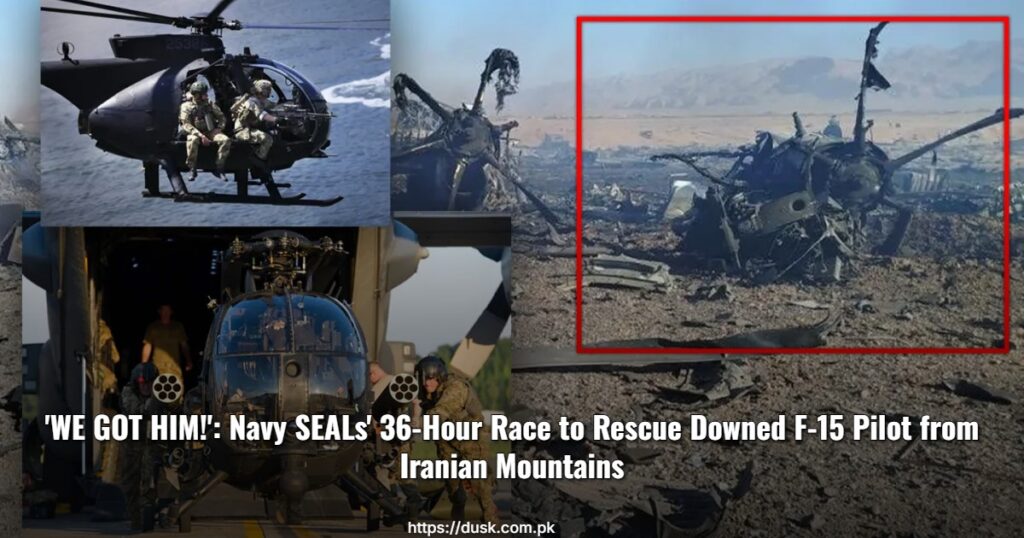
What followed was one of the most complex and dangerous combat search-and-rescue operations in modern US military history. Navy SEAL Team 6 commandos, CIA deception officers, hundreds of special operations troops, and dozens of aircraft converged on Iranian territory in a life-or-death race against Iranian forces . By Sunday morning, President Donald Trump was able to announce on Truth Social: “WE GOT HIM!” .
The Shot Down: How an F-15E Strike Eagle Fell Over Southern Iran
First US Combat Loss in More Than 20 Years
The incident began on Friday, April 3, when an F-15E Strike Eagle — a dual-role fighter designed for both air-to-air combat and ground attack — was on a mission over southwestern Iran . The aircraft was likely conducting Defensive Counter Air operations, hunting Iranian drones and cruise missiles, or carrying out precision strikes against military targets .
Then, Iranian air defenses locked on.
According to US officials, the jet was struck by an Iranian surface-to-air missile. Both crew members — the pilot in the front seat and the weapons systems officer in the back — ejected before the aircraft crashed into the mountainous terrain below .
The pilot was located and rescued relatively quickly by US forces. But the weapons systems officer — a colonel whose name has not been released — could not be found . His fate was unknown. And the clock was ticking.
The downing of the F-15E was a significant propaganda victory for Iran, which had endured weeks of US and Israeli airstrikes that Washington claimed had “decimated” its air defense capabilities . The shoot-down proved that, despite Trump’s assertions of “overwhelming Air Dominance,” Iran still retained some capacity to defend its skies .
Iranian Air Defense Claims: ‘Majid’ System and Passive Sensors
Iranian state media quickly claimed responsibility, releasing footage that appeared to show the engagement . Military analysts noted that the footage used electro-optical and infrared sensors rather than traditional radar — suggesting Iran may be relying on passive detection systems that are harder for US aircraft to jam .
One system that may have been involved is Iran’s indigenous “Majid” (AD-08) short-range air defense system, which uses passive imaging infrared homing to track and engage targets without emitting radar signals . The system is mounted on mobile vehicles and is designed to engage low-flying aircraft, helicopters, and drones at ranges up to 8 kilometers .
While tracking a high-speed fighter jet like the F-15E with infrared sensors is “extremely difficult,” analysts noted that it is not impossible — and Iran’s success demonstrated that the country’s air defense network, while degraded, was not destroyed .
The downing also raised questions about the Trump administration’s repeated claims of victory. As one BBC correspondent noted: “This shows that Iran still retains — albeit likely a limited and very reduced — capacity to defend its skies” .
The Race Against Time: 36 Hours Behind Enemy Lines
Colonel’s Survival: A Pistol, a Mountain Crevice, and a 7,000-Foot Climb
After ejecting from the stricken F-15E, the Air Force colonel found himself alone in hostile territory. He was armed only with a pistol — the standard survival sidearm for downed airmen — and equipped with a beacon and secure communication device .
His training kicked in immediately. The officer’s first priority was to evade capture. He moved away from the crash site, hiking up a 7,000-foot ridgeline to find cover . Eventually, he discovered a mountain crevice — a narrow gap in the rocks where he could hide from Iranian search parties .
For more than 24 hours, he remained there, injured from the ejection but able to move . He restricted the use of his beacon, knowing that while it could help US forces find him, Iranian forces might also detect its signal .
His survival was aided by the location. The F-15E went down in a part of Iran where there is “significant opposition to the Iranian government” . The local population, historically resistant to Tehran’s rule, may have been less inclined to help Iranian forces locate the downed American — and may even have provided him with shelter or assistance .
Iran’s Bounty: $66,000 for Capture ‘Alive’
Iranian authorities were not taking chances. The governor of Kohgiluyeh and Boyer-Ahmad province, Yadollah Rahmani, issued a direct appeal to residents: “The people of the province, particularly those in tribal areas, are doing their utmost to find these pilots. If enemy forces are spotted, capturing them alive is a priority” .
A reward of 10 billion tomans — approximately $66,000 — was offered to any Iranian citizen who captured the downed airman alive . Videos on social media appeared to show hundreds of locals heading into the mountainous area to join the search .
The stakes could not have been higher. If Iranian forces had found the colonel first, he would have become a prisoner of war — a propaganda tool for Tehran and a bargaining chip in any future negotiations. As one White House correspondent put it: “The US could have faced a prisoner of war situation with the captured crew used for Iranian propaganda” .
CIA Deception: The Disinformation Campaign That Saved a Life
While the colonel hid in his mountain crevice, the CIA launched an elaborate deception campaign inside Iran .
The agency spread word — through whatever channels were available — that US forces had already found the missing airman and were moving him out of the country in a ground convoy . The goal was to confuse Iranian forces, convincing them that the race was already lost and that further searching was pointless .
Simultaneously, the CIA used its intelligence capabilities to track the colonel’s exact location. According to a senior administration official, the agency found his hiding place — “the ultimate needle in a haystack” — and passed the coordinates to the Pentagon .
A senior US official told Barak Ravid of Axios: “This was the ultimate needle in a haystack, but in this case it was a brave American soul inside a mountain crevice, invisible but for CIA’s capabilities” .
The Rescue: Navy SEAL Team 6’s Daring Night Mission
Hundreds of Troops, Dozens of Aircraft
With the colonel’s location confirmed, US Central Command launched what would become one of the largest combat search-and-rescue operations in recent memory.
At Trump’s direction, the US military “sent dozens of aircraft, armed with the most lethal weapons in the World” into Iranian airspace . The operation involved:
- Navy SEAL Team 6 — the elite counterterrorism unit that killed Osama bin Laden — tasked with extracting the colonel from his mountain hideout
- Hundreds of special operations troops providing support and security
- Multiple helicopters — including Black Hawks — to transport commandos to and from the extraction point
- Combat aircraft — including A-10 Warthogs and other attack planes — to provide air cover and suppress Iranian forces
- C-130 transport planes to fly the rescued airman and the rescue force out of Iran
The mission was launched after nightfall, when US forces — trained and equipped for nighttime operations — would have a tactical advantage .
A-10 Warthog Hit, Pilot Ejects Over Gulf
The rescue mission was not without cost. According to US officials, an A-10 Warthog — a heavily armored attack aircraft designed for close air support — was hit by Iranian fire during the operation .
The pilot ejected safely over the Gulf and was rescued . Iranian state media, however, claimed the aircraft was shot down by its air defense systems and released footage of the engagement .
Additionally, a helicopter carrying the previously rescued F-15E pilot was hit by small arms fire, injuring crew members on board. The helicopter landed safely .
Firefight with Iranian Forces
The rescue operation involved direct engagement between US and Iranian forces. According to the BBC, there was “engagement” between US and Iranian forces during the rescue, with US aircraft dropping bombs and opening fire on Iranian convoys to keep them away from the colonel’s location .
US commandos also fired their weapons to keep Iranian forces away from the rescue site as they converged on the airman . However, US officials told The New York Times that they did not engage in a direct firefight with enemy forces — suggesting the engagement was primarily suppressive rather than a pitched battle .
Despite the intensity of the operation, Trump emphasized that “no Americans were killed or wounded” — a remarkable outcome given the risks involved .
The Final Twist: Two C-130s Stuck, Three More Flown In, Aircraft Destroyed
Just when it seemed the mission was complete, a final obstacle emerged.
The colonel and his SEAL Team 6 rescuers were transported by helicopter to a remote, sandy airstrip inside Iran that Special Operations forces had previously developed for exactly this kind of contingency . The plan was to load everyone onto two C-130 transport planes and fly them to safety in Kuwait .
But the sandy terrain proved treacherous. The nose gear of at least one — and possibly both — C-130s became stuck in the soft dirt . Efforts to free the wheels failed. Hours passed.
Pentagon and Centcom officials waited anxiously. The success of a dangerous mission, which had seemed nearly complete, was suddenly uncertain again .
Commanders made a quick decision. Three replacement aircraft were called in . The commandos and the injured colonel were reloaded onto the new planes. As the sun began to rise, the three aircraft launched in succession — the plane carrying the rescued airman going first .
But the two disabled C-130s could not be left behind. Rather than let them fall into Iranian hands — along with any sensitive equipment or intelligence they might contain — American warplanes bombed the stranded aircraft, destroying them where they sat .
The decision was dramatic but necessary. As one US official put it: “The US was not going to leave behind sensitive material for Iran to exploit” .
The Announcement: Trump’s Truth Social Triumph
‘One of the Most Daring Rescue Operations in US History’
Just before midnight on Saturday, April 4 — as the rescue operation concluded — Trump took to Truth Social with an all-caps announcement:
“WE GOT HIM! My fellow Americans, over the past several hours, the United States Military pulled off one of the most daring Search and Rescue Operations in U.S. History” .
Trump described the rescued officer — whom he identified as a “highly respected Colonel” — as having been “behind enemy lines in the treacherous mountains of Iran, being hunted down by our enemies, who were getting closer and closer by the hour” .
The president said US forces “were monitoring his location 24 hours a day” and that at his direction, “the U.S. Military sent dozens of aircraft, armed with the most lethal weapons in the World, to retrieve him” .
‘No American Killed or Even Wounded’
Trump also emphasized that the operation was carried out “without a SINGLE American killed, or even wounded” — despite the engagement with Iranian forces, the downing of the A-10, and the injuries sustained by helicopter crew members .
“The fact that we were able to pull off both of these operations, without a SINGLE American killed, or even wounded, just proves once again, that we have achieved overwhelming Air Dominance and Superiority over the Iranian skies,” Trump wrote .
The rescued colonel “sustained injuries, but he will be just fine,” Trump added .
He concluded with a holiday flourish: “GOD BLESS AMERICA, GOD BLESS OUR TROOPS, AND HAPPY EASTER TO ALL!” .
Iran’s Counter-Narrative: ‘Complete Failure’
IRGC Claims US Aircraft Destroyed
Iranian officials quickly rejected Trump’s narrative, claiming the rescue mission was a “complete failure” .
A spokesman for the Khatam al-Anbiya Central Headquarters — Iran’s top military command — said: “The enemy’s desperate efforts to rescue its downed fighter pilot failed thanks to Almighty God’s blessings and divine assistance, as well as the timely actions and joint operations of Iranian forces” .
Iran’s Islamic Revolutionary Guard Corps claimed that US forces had used an abandoned airport in Isfahan province for the operation and that Iranian forces had destroyed two C-130 transport planes and two Black Hawk helicopters .
State television broadcast images of the charred wreckage of what appeared to be aircraft in a desert area — though the footage appeared to show the aftermath of the US military’s decision to destroy its own stranded planes, not Iranian combat victories .
Parliament Speaker Mocks: ‘If the US Gets Three More Victories Like This, It Will Be Utterly Ruined’
Iran’s Parliament Speaker, Mohammad Bagher Ghalibaf — who has been active on social media throughout the war — responded with characteristic sarcasm.
“If the United States gets three more victories like this, it will be utterly ruined,” Ghalibaf posted on X, alongside an image of the wreckage .
The post was a pointed reference to the loss of two US transport planes, which Iran claimed as proof of American vulnerability.
Ghalibaf also mocked Trump’s earlier claims that the war was won, posting earlier in the week: “After defeating Iran 37 times in a row, this brilliant no-strategy war they started has now been downgraded from ‘regime change’ to ‘Hey! Can anyone find our pilots? Please?'” .
The dueling narratives — Trump’s celebration of a daring rescue, Iran’s mockery of American losses — reflected the broader information war being fought alongside the military conflict.
The Broader War: Strikes Continue Across the Gulf
UAE, Bahrain, Kuwait Hit
Even as the rescue operation unfolded, Iranian strikes continued across the Gulf region.
In the UAE, authorities responded to “multiple fires” at the Borouge petrochemicals plant in Abu Dhabi, caused by falling debris from intercepted missiles . The Fujairah oil complex — a critical facility that allows the UAE to bypass the Strait of Hormuz for some exports — has been hit multiple times in recent days .
In Bahrain, the Gulf Petrochemical Industries Company reported that a facility was hit by a drone attack, though fires were quickly extinguished . A tank fire was also reported at Bapco Energies, Bahrain’s state oil company .
In Kuwait, two power generation and water desalination plants were hit by what authorities said were Iranian drone strikes . Desalination plants are a particularly sensitive target in the water-scarce Gulf region, where desalinated water provides the vast majority of drinking water.
Israel Strikes 120+ Targets in Iran
Israel, which has been coordinating closely with the United States throughout the war, continued its own campaign against Iranian targets.
The Israel Defense Forces said it struck more than 120 targets in central and western Iran over a 24-hour period, including ballistic missile launch sites and drone facilities . Iranian media reported explosions in Tehran and elsewhere as air defenses activated .
Israeli Prime Minister Benjamin Netanyahu has said Israeli strikes have destroyed 70% of Iran’s steel production capacity — a significant blow to the Iranian economy — and vowed that Israel and the US would continue to “crush” the country .
Expert Analysis: What This Means for the War
Iran Still Has Fight Left
The downing of the F-15E sent a clear message: despite weeks of relentless airstrikes, Iran still has the ability to defend its skies.
“This shows that Iran still retains — albeit likely a limited and very reduced — capacity to defend its skies,” one BBC correspondent noted . The shoot-down also raised questions about the Trump administration’s repeated claims of “air superiority” and suggestions that Iran’s military capabilities had been “decimated” .
For the US military, the incident served as a sobering reminder that combat remains dangerous, even against a degraded adversary. As one military expert told the BBC: “When flying over hostile territory, you have to be prepared to be the person that’s hit” .
The ‘Never Leave a Fallen Comrade’ Ethos
For the US military, the successful rescue was a powerful affirmation of its core ethos: never leave a fallen comrade behind.
Mick Mulroy, a former US Marine, CIA paramilitary officer, and Deputy Assistant Secretary of Defense for the Middle East, told the BBC: “The US military has an ethos to never leave someone behind. Today was an incredible example of that core commitment” .
Military experts noted that the success rate for this type of operation is “usually very, very low” . That the mission succeeded — and without US casualties — was a testament to the training, courage, and coordination of the special operations forces involved.
Strategic Victory for Trump
Politically, the rescue provided a much-needed victory for Trump, who has faced criticism over the war’s mounting costs and his administration’s inability to secure allied support.
“Trump is turning a propaganda problem into a cause for celebration,” one BBC correspondent observed . “For 48 hours, he had faced the prospect of a serving US airman being captured by Iran and most likely paraded on state TV.”
Instead, Trump was able to announce a successful rescue — and to use it as evidence that the US had achieved “overwhelming Air Dominance” over Iran .
The rescue also demonstrated the reach and capability of US special operations forces, sending a message to Iran — and to the world — that the United States can project power deep into enemy territory and extract its personnel under fire.
Conclusion: The Pilot Who Walked Out of Iran
In the annals of US military history, few rescue operations compare to what unfolded over those 36 hours in April 2026.
An Air Force colonel, shot down over hostile territory, armed only with a pistol and his training, evaded capture for more than a day while Iranian forces — backed by a $66,000 bounty — scoured the mountains for him .
The CIA tracked him to a mountain crevice and launched a deception campaign to confuse his pursuers .
Navy SEAL Team 6 — the same unit that killed Osama bin Laden — flew into Iranian territory under the cover of darkness, supported by dozens of aircraft and hundreds of special operations troops .
They found him. They extracted him. They flew him to safety.
Along the way, an A-10 Warthog was shot down, helicopters were hit by small arms fire, and two C-130 transport planes got stuck in the sand and had to be destroyed .
But in the end, every American came home.
And for one Air Force colonel — and the nation that sent its best to bring him back — that was all that mattered.
Join Dusk on WhatsApp
Get the latest news, videos and blogs straight to your phone.
Join Now